Updated
Citizen Tsuyosa vs Tissot PRX Powermatic 80
The two integrated-bracelet automatics everyone compares
Quick Verdict
The Citizen Tsuyosa ($250–$500) and the Tissot PRX Powermatic 80 ($500–$1,000) are both 40mm steel automatics with integrated bracelets and sapphire crystals. The PRX has double the power reserve (80 hours against 40) and double the water rating (100m against 50m), and it is Swiss made. The Tsuyosa costs a band less.
Transparency — We earn a small commission on purchases made through our Amazon links. This doesn't affect our editorial independence.

Specifications Compared
| Feature | Citizen Tsuyosa Automatic | Tissot PRX Powermatic 80 |
|---|---|---|
| Price | $250–$500 | $500–$1,000 |
| Case Size | 40mm | 40mm |
| Movement | Automatic Caliber 8210 | Automatic Powermatic 80.111 |
| Caliber Type | Citizen/Miyota In-House Automatic | In-House Automatic (ETA C07.111 base) |
| Power Reserve | 40 Hours | 80 Hours |
| Water Resistance | 50m (5 ATM) | 100m (10 ATM) |
| Crystal | Sapphire Crystal with Cyclops | Scratch-resistant Sapphire |
| Case Material | Stainless Steel | 316L Stainless Steel |
| Origin | Made in Japan | Swiss Made |
Category-by-Category Analysis
Design & Aesthetics
Same idea, different details
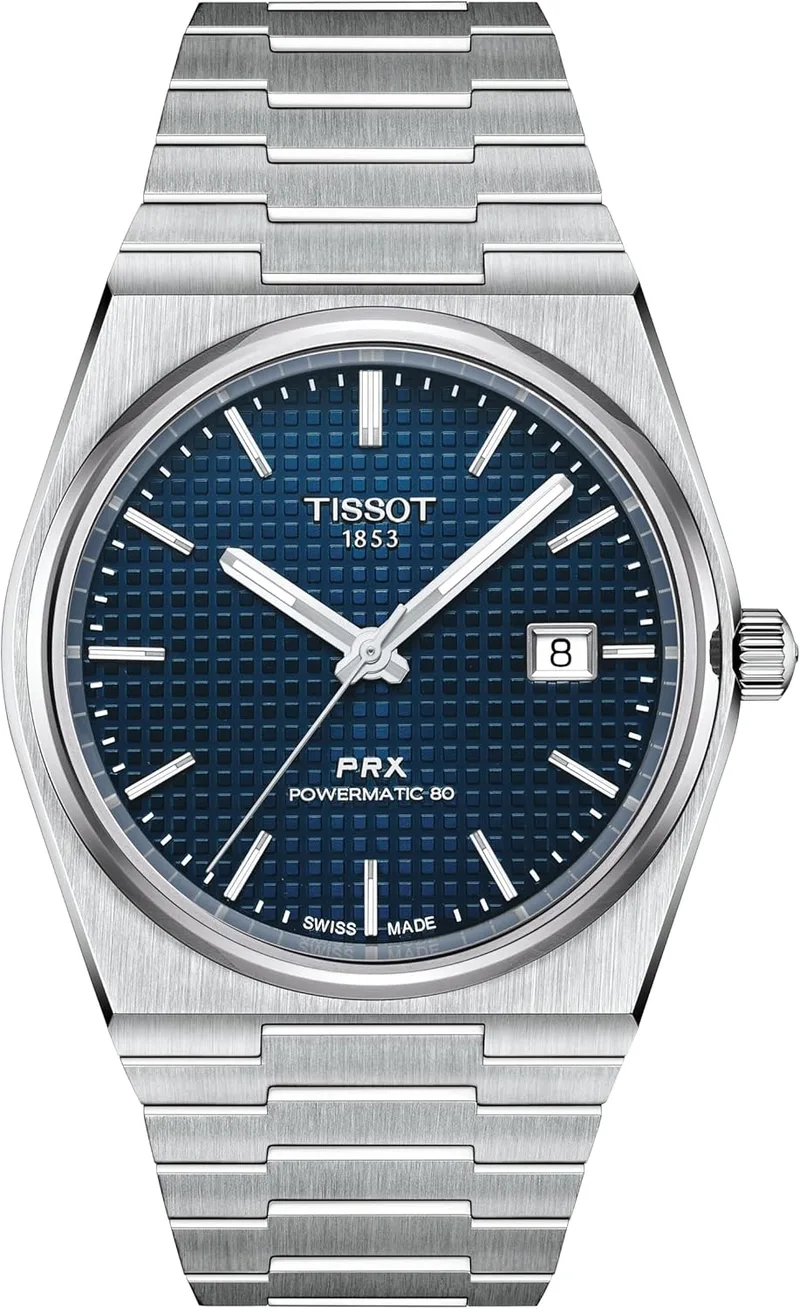
Both are 40mm steel watches with integrated bracelets in the 1970s sports-luxury tradition. The PRX has a waffle-textured dial; the Tsuyosa has vibrant dial colours and a cyclops date magnifier. Pick the one whose dial you like.
Movement & Performance
80 hours against 40
The PRX runs the Swiss Powermatic 80.111, 23 jewels at 21,600 vph, with an 80-hour reserve. The Tsuyosa runs Citizen's calibre 8210, 21 jewels at 21,600 vph, with a 40-hour reserve. The PRX will still be running after a weekend off the wrist; the Tsuyosa will likely need resetting.
Durability & Water Resistance
100m against 50m
Both use sapphire crystals; the Tsuyosa adds a cyclops over the date. The PRX is rated to 100m (10 ATM) and the Tsuyosa to 50m (5 ATM). The PRX is the one to wear swimming.
Wearability & Fit
Both 40mm
Both are 40mm on integrated bracelets. On diameter they are the same; integrated bracelets can wear larger than the number suggests, so try both if you can.
Value & Cost of Ownership
The Tsuyosa is a band cheaper
The Tsuyosa sits in the $250–$500 band and the PRX in $500–$1,000. The PRX earns its premium with the reserve and water rating; the Tsuyosa gives you the look and sapphire for less.
Materials Face-Off
| Component | Citizen Tsuyosa Automatic | Tissot PRX Powermatic 80 |
|---|---|---|
| Case alloy | Stainless steel 316L. | Stainless steel 316L (medical-grade, with composition Cr 16–18%, Ni 10–14%, Mo 2–3%) — the standard mid-range Swiss spec; not 904L (Rolex Oystersteel |
| Sapphire crystal | Verneuil-grown synthetic corundum, Mohs 9. Anti-reflective coating, single side. Mohs 9 | Synthetic corundum (Al₂O₃) grown via the Verneuil process, Mohs hardness 9. Anti-reflective coating on the interior surface only (single-side AR is st Mohs 9 |
| Lume specification | Super-LumiNova on the hands and markers. The application is light - this is not a watch to rely on for low-light legibility. Grade and glow duration are not published by the manufacturer for this reference, so neither is claimed here. | Super-LumiNova on the hands and markers. Grade and glow duration are not published by the manufacturer for this reference, so neither is claimed here. |
| Bracelet alloy | Stainless steel 316L matching the case. | Stainless steel 316L matching the case. |
Cost of Ownership Compared
The Citizen Tsuyosa Automatic saves you $250–$500 over 5 years of ownership
Who Should Pick Which
Pick the Citizen Tsuyosa Automatic if…
- Budget-conscious buyers wanting serious quality under $500
- Those who prioritize scratch resistance — sapphire crystal
Pick the Tissot PRX Powermatic 80 if…
- Strong value proposition under $1,000 with automatic Swiss movement
- Active lifestyle wearers — 100m water resistance handles swimming and water sports
- Weekend warriors — 80-hour power reserve means it survives two days off the wrist
- Those who prioritize scratch resistance — sapphire crystal
- Integrated-bracelet aesthetic fans wanting the Royal Oak look for 1/20th the price
Citizen Tsuyosa Automatic
- No hacking seconds. When you pull the crown to set the time, the seconds hand continues running. Setting precisely to-the-second is impossible. The single most-cited Tsuyosa complaint.
- Unidirectional rotor. Only winds in one direction; reserves take longer to build than bidirectional movements.
- Modest accuracy spec. ±10 to +25 sec/day in practice is the realistic band; significantly worse than the Tissot Powermatic 80.
- Proprietary endlinks. Limited strap-swap options.
Tissot PRX Powermatic 80
- Retail markup is generous. The PRX commonly transacts well under list on Jomashop, in Tissot's own online promotions, and at authorized online dealers. Paying full retail is rarely the right move, because the street price sits below it.
- Proprietary endlink limits strap options. The integrated bracelet design means you cannot easily put a NATO, leather two-piece, or rubber strap on the PRX without specialist hardware. This bothers some buyers more than they expect.
- Bracelet sizing is fiddly. Links are joined by screws (good — adjustable at home with a tool), but the screws are tiny and stripping them is common for inexperienced owners. Take it to a watchmaker for sizing if you're unsure.
- 3 Hz "slow" seconds. The reduced frequency (21,600 vph vs. 28,800 vph in some peer movements) means the seconds hand visibly sweeps at 6 ticks/second rather than 8. Some buyers expecting the smoother high-beat sweep find this a minor disappointment.
Our Verdict
Citizen
Tsuyosa Automatic
Choose the Citizen Tsuyosa if you want the integrated-bracelet look for less money. It has a sapphire crystal, a cyclops over the date, and bright dial colours.
Check Price on AmazonTissot
PRX Powermatic 80
Choose the Tissot PRX Powermatic 80 if you can stretch a band. It doubles the reserve to 80 hours, so it survives a weekend off the wrist, and doubles the water rating to 100m, which makes swimming fine.
Check Price on AmazonThe Bottom Line
The Citizen Tsuyosa and the Tissot PRX Powermatic 80 are both 40mm integrated-bracelet automatics with sapphire crystals, but the PRX has an 80-hour power reserve and 100m water resistance against the Tsuyosa's 40 hours and 50m, in a higher price band.
Frequently Asked Questions
More Comparisons
Explore These Watches
How This Page Was Made
Our comparisons are generated from a hand-maintained specification database and reviewed under our editorial standards. We use AI tools to assemble pages from that data. We don’t invent specs: every number traces back to the database, and when we correct an entry, the fix is applied site-wide. As an Amazon Associate, The Horologist earns from qualifying purchases.