Junghans Max Bill Chronoscope vs Rado True Square Automatic
Junghans's chronograph meets Rado's timepiece
Quick Verdict
The Rado True Square Automatic ($1,500–$2,500) delivers Powermatic 80 (ETA-Based) technology in the tier below the Junghans Max Bill Chronoscope ($2,500–$5,000). The True Square Automatic measures 38mm (Square) and is rated 50m (5 ATM). The Max Bill Chronoscope justifies its premium with Made in Germany heritage and Automatic Caliber J880.2. Both represent excellent choices in the luxury watch category.
Transparency — We earn a small commission on purchases made through our Amazon links. This doesn't affect our editorial independence.
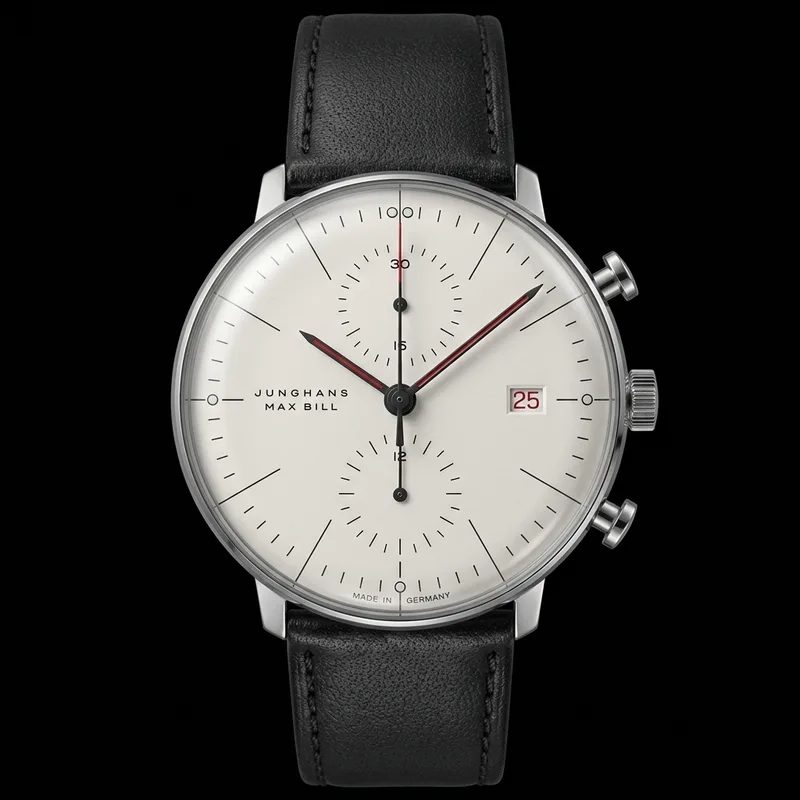
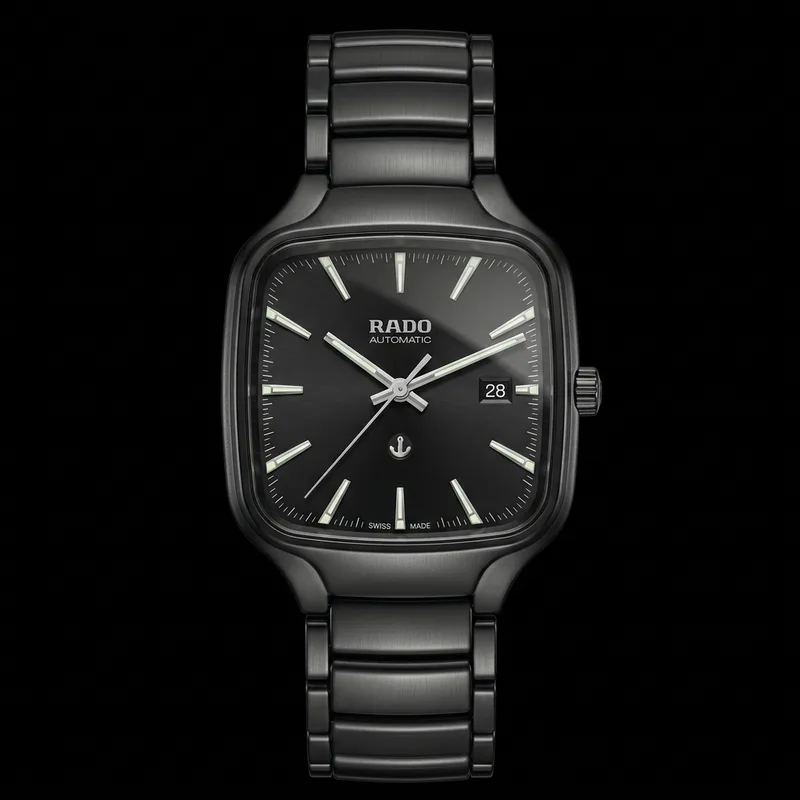
Specifications Compared
| Feature | Junghans Max Bill Chronoscope | Rado True Square Automatic |
|---|---|---|
| Price | $2,500–$5,000 | $1,500–$2,500 |
| Case Size | 40mm | 38mm (Square) |
| Movement | Automatic Caliber J880.2 | Automatic ETA C07.611 |
| Caliber Type | Automatic (ETA 2824-2 base) | Powermatic 80 (ETA-Based) |
| Power Reserve | 48 Hours | 80 Hours |
| Water Resistance | Splash Resistant | 50m (5 ATM) |
| Crystal | Convex Hard Plexiglass (SICRALAN coated) | Sapphire (Anti-Reflective) |
| Case Material | Stainless Steel | Monobloc High-Tech Ceramic |
| Origin | Made in Germany | Swiss Made |
Category-by-Category Analysis
Design & Aesthetics
Junghans's design language vs Rado's approach
The Junghans Max Bill Chronoscope features a Stainless Steel case at 40mm with Convex Hard Plexiglass (SICRALAN coated) protection. The Rado True Square Automatic offers Monobloc High-Tech Ceramic construction at 38mm (Square) with Sapphire (Anti-Reflective). Both represent their brand's distinct design philosophy and heritage.
Movement & Performance
Automatic Caliber J880.2 vs Automatic ETA C07.611
The Max Bill Chronoscope runs the Automatic Caliber J880.2 (Automatic (ETA 2824-2 base), 48 Hours power reserve) at 28,800 vph (4 Hz) frequency. The True Square Automatic uses the Automatic ETA C07.611 (Powermatic 80 (ETA-Based), 80 Hours reserve) at 21,600 vph (3 Hz). The True Square Automatic offers a longer power reserve.
Wearability & Fit
40mm vs 38mm (Square) — different wrist presence
At 40mm, the Max Bill Chronoscope has a bolder wrist presence compared to the True Square Automatic at 38mm (Square). Water resistance differs: Splash Resistant vs 50m (5 ATM).
Value & Cost of Ownership
Rado sits in the lower tier
The Junghans Max Bill Chronoscope sits at $2,500–$5,000 and the Rado True Square Automatic at $1,500–$2,500. On the specs that outlast any price: the Max Bill Chronoscope uses Convex Hard Plexiglass (SICRALAN coated) with 48 Hours, against Sapphire (Anti-Reflective) and 80 Hours on the True Square Automatic. Service intervals are typically 5-7 years for both.
Water Resistance
Splash Resistant vs 50m (5 ATM)
The Max Bill Chronoscope is rated to Splash Resistant while the True Square Automatic handles 50m (5 ATM). The True Square Automatic offers superior water resistance.
Materials Face-Off
| Component | Junghans Max Bill Chronoscope | Rado True Square Automatic |
|---|---|---|
| Case alloy | Stainless steel 316L. | Rado's proprietary zirconium dioxide (ZrO₂) ceramic, fired at temperatures higher than standard ceramic to produce a more scratch-resistant material w |
| Crystal | Convex hard plexiglass (acrylic) with SICRALAN scratch-resistant coating — a Junghans proprietary surface treatment that hardens the acrylic and give | ceramic enriched with carbon during a plasma-treatment phase at 20,000°C, resulting in a sheen that is more metallic. Owners describe the appearance a |
| Lume specification | Not applicable — the Max Bill dial does not use lume. | Sapphire (Al₂O₃) grown via Verneuil process, Mohs 9, with anti-reflective coating. Mohs 9 |
| Strap material | Calfskin leather (black, brown variants), nubuck, or Milanese mesh stainless steel bracelet. | Super-LumiNova (variable by dial variant). |
| Bracelet | — | Monobloc ceramic matching the case, with titanium clasp components. |
Cost of Ownership Compared
The Rado True Square Automatic saves you $157 over 5 years of ownership
Who Should Pick Which
Pick the Junghans Max Bill Chronoscope if…
- Those who prioritize scratch resistance — sapphire crystal
- Chronograph enthusiasts looking for a proven timing instrument
- Dress watch seekers who want understated elegance
- Heritage enthusiasts drawn to ** Junghans's historical pedigree
Pick the Rado True Square Automatic if…
- Weekend warriors — 80-hour power reserve means it survives two days off the wrist
- Those who prioritize scratch resistance — sapphire crystal
- Dress watch seekers who want understated elegance
Junghans Max Bill Chronoscope
- Valjoux 7750 base at a $1,500–$2,500 band price. Some buyers feel the base movement doesn't justify the retail price. The defense: you pay for the design heritage and German assembly, not the movement engineering.
- Acrylic crystal scratches. The SICRALAN coating helps but doesn't make it sapphire-equivalent. Buyers expecting absolute scratch resistance should choose a sapphire-crystal sibling reference.
- No lume. The Max Bill dial is intentionally lume-free — Bauhaus design principles take precedence over practical readability in the dark.
- 14.4mm thickness. The 7750-based Chronoscope is inevitably thick for what reads visually as a slim dress watch. The proportions feel less honest than the 38mm time-only Max Bill Automatic.
Rado True Square Automatic
- Ceramic brittleness — virtually scratchproof but can crack/shatter under hard impacts. WatchUSeek Rado threads document multiple owner reports of ceramic cracking from drops that would only scratch steel cases. Insurance is recommended.
- Square format polarising — distinctive and modernist, but not for buyers who want traditional round cases.
- 50m water resistance — dress watch only; not for swimming sports or hard activity.
- Proprietary endlinks — severely limits aftermarket strap options.
Our Verdict
Junghans
Max Bill Chronoscope
Choose the Junghans Max Bill Chronoscope if you prioritize Automatic (ETA 2824-2 base) engineering, Made in Germany craftsmanship, and Splash Resistant water resistance. At $2,500–$5,000, it delivers Automatic Caliber J880.2 with 48 Hours power reserve.
Check Price on AmazonRado
True Square Automatic
Choose the Rado True Square Automatic if you value Powermatic 80 (ETA-Based) technology, Swiss Made heritage, and 38mm (Square) proportions. At $1,500–$2,500, the Automatic ETA C07.611 with 80 Hours power reserve makes it a compelling choice.
Check Price on AmazonThe Bottom Line
The Junghans Max Bill Chronoscope and Rado True Square Automatic represent two distinct approaches to fine watchmaking — the Junghans bringing Made in Germany tradition while Rado delivers Swiss Made engineering.
Frequently Asked Questions
More Comparisons
TAG Heuer Carrera vs Junghans Max Bill Chronoscope
Swiss racing heritage meets German Bauhaus design
Tag Heuer Carrera Chronograph vs Rado True Square Automatic
Tag Heuer's chronograph meets Rado's timepiece
Tissot PRX Powermatic 80 vs Junghans Max Bill Chronoscope
Tissot's timepiece meets Junghans's chronograph
Explore These Watches
How This Page Was Made
Our comparisons are generated from a hand-maintained specification database and reviewed under our editorial standards. We use AI tools to assemble pages from that data. We don’t invent specs: every number traces back to the database, and when we correct an entry, the fix is applied site-wide. As an Amazon Associate, The Horologist earns from qualifying purchases.