Junghans Max Bill Chronoscope vs Tudor Black Bay 58
Junghans's chronograph meets Tudor's diver
Quick Verdict
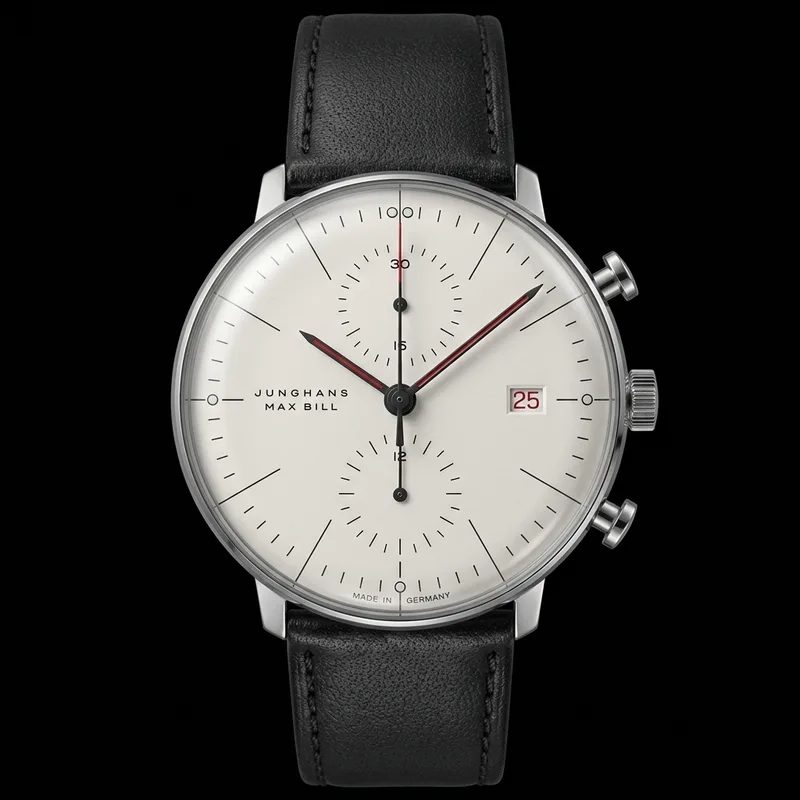
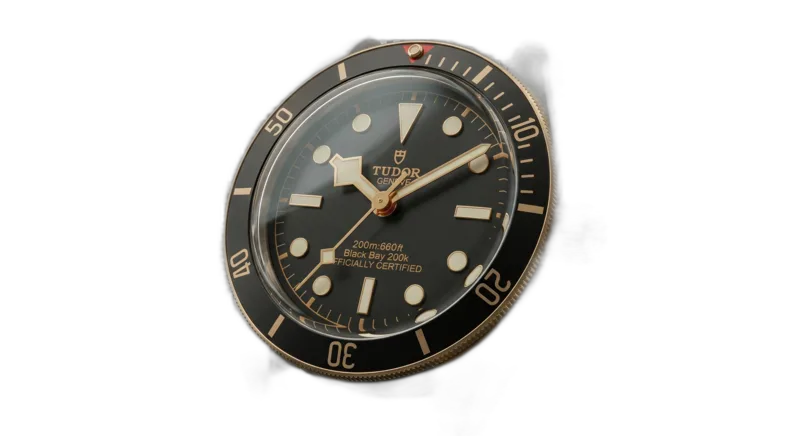
The Junghans Max Bill Chronoscope ($2,500–$5,000) and Tudor Black Bay 58 ($2,500–$5,000) are closely matched timepieces at similar price points. The Max Bill Chronoscope emphasizes Automatic (ETA 2824-2 base) engineering while the Black Bay 58 focuses on Swiss Made craftsmanship.
Transparency — We earn a small commission on purchases made through our Amazon links. This doesn't affect our editorial independence.
Specifications Compared
| Feature | Junghans Max Bill Chronoscope | Tudor Black Bay 58 |
|---|---|---|
| Price | $2,500–$5,000 | $2,500–$5,000 |
| Case Size | 40mm | 39mm |
| Movement | Automatic Caliber J880.2 | Automatic Manufacture Calibre MT5402 |
| Caliber Type | Automatic (ETA 2824-2 base) | In-House Automatic Manufacture (Kenissi) |
| Power Reserve | 48 Hours | 70 Hours |
| Water Resistance | Splash Resistant | 200m (20 ATM) |
| Crystal | Convex Hard Plexiglass (SICRALAN coated) | Domed Sapphire |
| Case Material | Stainless Steel | 316L Stainless Steel |
| Origin | Made in Germany | Swiss Made |
Category-by-Category Analysis
Design & Aesthetics
Junghans's design language vs Tudor's approach
The Junghans Max Bill Chronoscope features a Stainless Steel case at 40mm with Convex Hard Plexiglass (SICRALAN coated) protection. The Tudor Black Bay 58 offers 316L Stainless Steel construction at 39mm with Domed Sapphire. Both represent their brand's distinct design philosophy and heritage.
Movement & Performance
Automatic Caliber J880.2 vs Automatic Manufacture Calibre MT5402
The Max Bill Chronoscope runs the Automatic Caliber J880.2 (Automatic (ETA 2824-2 base), 48 Hours power reserve) at 28,800 vph (4 Hz) frequency. The Black Bay 58 uses the Automatic Manufacture Calibre MT5402 (In-House Automatic Manufacture (Kenissi), 70 Hours reserve) at 28,800 vph (4 Hz). The Black Bay 58 offers a longer power reserve.
Wearability & Fit
40mm vs 39mm — different wrist presence
At 40mm, the Max Bill Chronoscope has a bolder wrist presence compared to the Black Bay 58 at 39mm. Water resistance differs: Splash Resistant vs 200m (20 ATM).
Value & Cost of Ownership
Same tier — different value propositions
The Junghans Max Bill Chronoscope sits at $2,500–$5,000 and the Tudor Black Bay 58 at $2,500–$5,000. On the specs that outlast any price: the Max Bill Chronoscope uses Convex Hard Plexiglass (SICRALAN coated) with 48 Hours, against Domed Sapphire and 70 Hours on the Black Bay 58. Service intervals are typically 5-7 years for both.
Water Resistance
Splash Resistant vs 200m (20 ATM)
The Max Bill Chronoscope is rated to Splash Resistant while the Black Bay 58 handles 200m (20 ATM). The Black Bay 58 offers superior water resistance.
Materials Face-Off
| Component | Junghans Max Bill Chronoscope | Tudor Black Bay 58 |
|---|---|---|
| Case alloy | Stainless steel 316L. | Fully in-house manufacture at Kenissi (Le Locle). 26mm × 4.99mm, 27 jewels, free-sprung balance with variable inertia regulation |
| Crystal | Convex hard plexiglass (acrylic) with SICRALAN scratch-resistant coating — a Junghans proprietary surface treatment that hardens the acrylic and give | Si hairspring providing antimagnetic protection and superior isochronism |
| Lume specification | Not applicable — the Max Bill dial does not use lume. | Synthetic corundum (Al₂O₃) grown via Verneuil process, anti-reflective coating on inner surface Mohs 9 |
| Strap material | Calfskin leather (black, brown variants), nubuck, or Milanese mesh stainless steel bracelet. | Anodized aluminum insert with engraved 60-minute dive scale — deliberately not ceramic |
| 316L Stainless Steel | — | Medical-grade 316L (Cr 16–18%, Ni 10–14%, Mo 2–3%). Satin-brushed tops, polished bevels |
Cost of Ownership Compared
The Junghans Max Bill Chronoscope saves you $1,431 over 5 years of ownership
Who Should Pick Which
Pick the Junghans Max Bill Chronoscope if…
- Those who prioritize scratch resistance — sapphire crystal
- Chronograph enthusiasts looking for a proven timing instrument
- Dress watch seekers who want understated elegance
- Heritage enthusiasts drawn to ** Junghans's historical pedigree
Pick the Tudor Black Bay 58 if…
- True in-house COSC-certified manufacture movement at sub-$4,000
- 39mm "perfect proportions" — fits virtually any wrist from 6" to 8"
- Heritage collectors — direct lineage to the 1958 Tudor Submariner Reference 7924
- Wilsdorf Foundation (Rolex sister) pedigree without the waitlist or pricing
- 10-year service interval — longest in Swiss watchmaking, an explicit confidence statement
Junghans Max Bill Chronoscope
- Valjoux 7750 base at a $1,500–$2,500 band price. Some buyers feel the base movement doesn't justify the retail price. The defense: you pay for the design heritage and German assembly, not the movement engineering.
- Acrylic crystal scratches. The SICRALAN coating helps but doesn't make it sapphire-equivalent. Buyers expecting absolute scratch resistance should choose a sapphire-crystal sibling reference.
- No lume. The Max Bill dial is intentionally lume-free — Bauhaus design principles take precedence over practical readability in the dark.
- 14.4mm thickness. The 7750-based Chronoscope is inevitably thick for what reads visually as a slim dress watch. The proportions feel less honest than the 38mm time-only Max Bill Automatic.
Tudor Black Bay 58
- No date complication — a feature for purists, but a limitation for daily-wearer buyers who want at-a-glance date
- 316L not 904L — Tudor uses standard steel, not Rolex's "Oystersteel" (practically irrelevant for the wearer)
- Aluminum bezel insert scratches more easily than ceramic — heritage-correct, but less daily-wear robust
- Bracelet endlinks are proprietary — limits aftermarket bracelet options (straps still work via drilled lug holes)
Our Verdict
Junghans
Max Bill Chronoscope
Choose the Junghans Max Bill Chronoscope if you prioritize Automatic (ETA 2824-2 base) engineering, Made in Germany craftsmanship, and Splash Resistant water resistance. At $2,500–$5,000, it delivers Automatic Caliber J880.2 with 48 Hours power reserve.
Check Price on AmazonTudor
Black Bay 58
Choose the Tudor Black Bay 58 if you value In-House Automatic Manufacture (Kenissi) technology, Swiss Made heritage, and 39mm proportions. At $2,500–$5,000, the Automatic Manufacture Calibre MT5402 with 70 Hours power reserve makes it a compelling choice.
Check Price on AmazonThe Bottom Line
The Junghans Max Bill Chronoscope and Tudor Black Bay 58 represent two distinct approaches to fine watchmaking — the Junghans bringing Made in Germany tradition while Tudor delivers Swiss Made engineering.
Frequently Asked Questions
More Comparisons
Explore These Watches
How This Page Was Made
Our comparisons are generated from a hand-maintained specification database and reviewed under our editorial standards. We use AI tools to assemble pages from that data. We don’t invent specs: every number traces back to the database, and when we correct an entry, the fix is applied site-wide. As an Amazon Associate, The Horologist earns from qualifying purchases.