Mido Multifort Powerwind Chronometer vs Oris Big Crown Pointer Date
Mido's chronograph meets Oris's pilot watch
Quick Verdict
The Mido Multifort Powerwind Chronometer ($1,000–$1,500) offers Silicon Balance Spring COSC Automatic precision in the tier below the Oris Big Crown Pointer Date ($1,500–$2,500). The Multifort Powerwind Chronometer measures 40mm and is rated 100m (10 ATM). The Big Crown Pointer Date counters with Swiss Made craftsmanship and 50m (5 ATM) water resistance. Both are exceptional watches for their respective tiers.
Transparency — We earn a small commission on purchases made through our Amazon links. This doesn't affect our editorial independence.
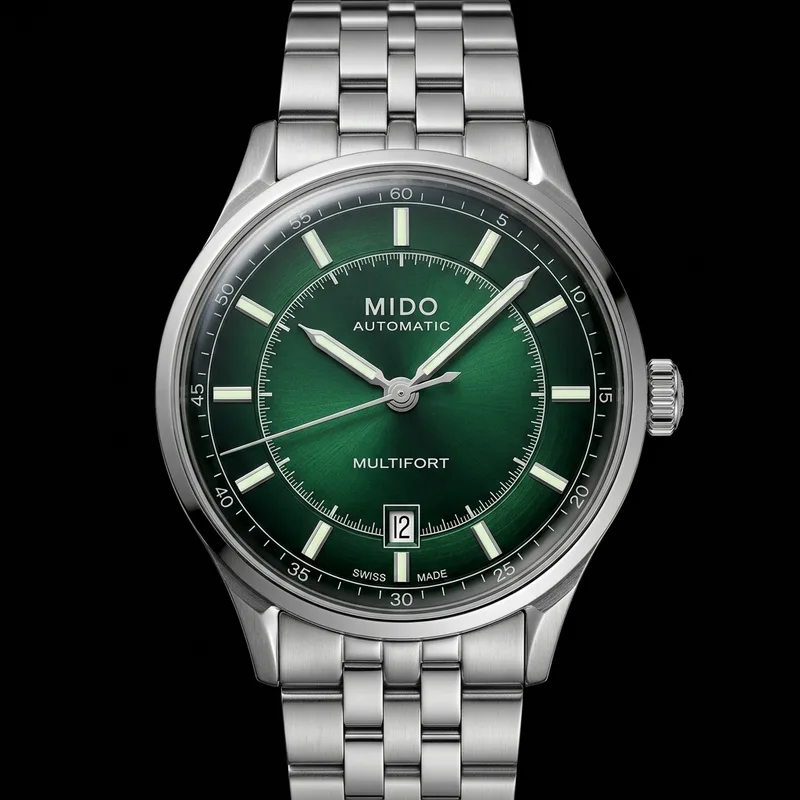
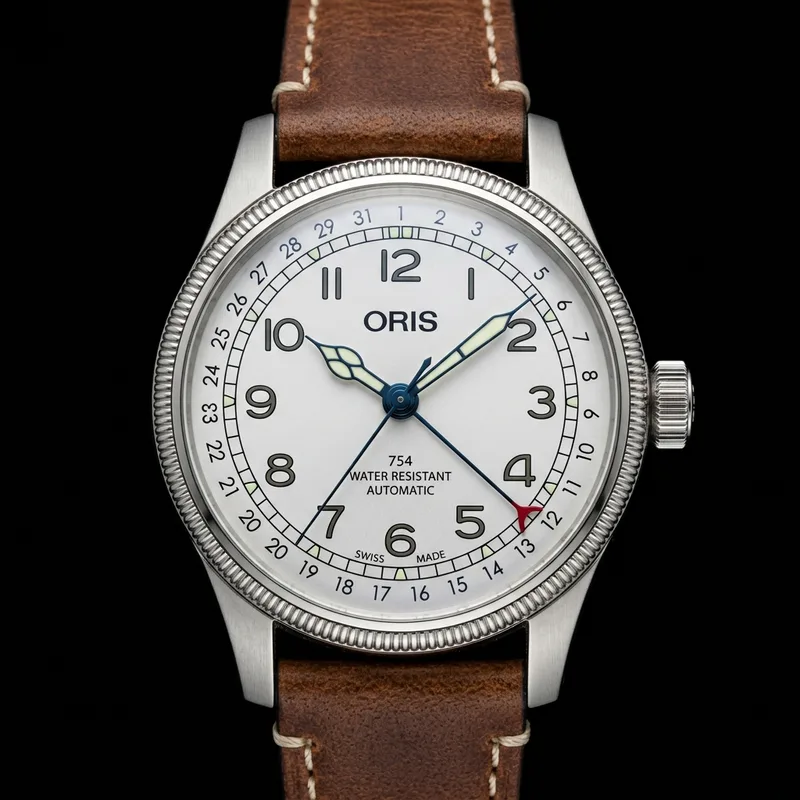
Specifications Compared
| Feature | Mido Multifort Powerwind Chronometer | Oris Big Crown Pointer Date |
|---|---|---|
| Price | $1,000–$1,500 | $1,500–$2,500 |
| Case Size | 40mm | 40mm |
| Movement | Automatic Caliber 80 Si (COSC) | Automatic Oris 754 (Sellita Base) |
| Caliber Type | Silicon Balance Spring COSC Automatic | Modified Sellita Automatic |
| Power Reserve | 80 Hours | 38 Hours |
| Water Resistance | 100m (10 ATM) | 50m (5 ATM) |
| Crystal | Sapphire with Anti-Reflective Coating | Sapphire (Domed, Inside AR Coating) |
| Case Material | Stainless Steel | Stainless Steel |
| Origin | Swiss Made | Swiss Made |
Category-by-Category Analysis
Design & Aesthetics
Mido's design language vs Oris's approach
The Mido Multifort Powerwind Chronometer features a Stainless Steel case at 40mm with Sapphire with Anti-Reflective Coating protection. The Oris Big Crown Pointer Date offers Stainless Steel construction at 40mm with Sapphire (Domed, Inside AR Coating). Both represent their brand's distinct design philosophy and heritage.
Movement & Performance
Automatic Caliber 80 Si (COSC) vs Automatic Oris 754 (Sellita Base)
The Multifort Powerwind Chronometer runs the Automatic Caliber 80 Si (COSC) (Silicon Balance Spring COSC Automatic, 80 Hours power reserve) at 21,600 vph (3 Hz) frequency. The Big Crown Pointer Date uses the Automatic Oris 754 (Sellita Base) (Modified Sellita Automatic, 38 Hours reserve) at 28,800 vph (4 Hz). The Multifort Powerwind Chronometer edges ahead on power reserve.
Wearability & Fit
40mm vs 40mm — different wrist presence
At 40mm, the Multifort Powerwind Chronometer is similarly sized compared to the Big Crown Pointer Date at 40mm. Water resistance differs: 100m (10 ATM) vs 50m (5 ATM).
Value & Cost of Ownership
Mido sits in the lower tier
The Mido Multifort Powerwind Chronometer sits at $1,000–$1,500 and the Oris Big Crown Pointer Date at $1,500–$2,500. On the specs that outlast any price: the Multifort Powerwind Chronometer uses Sapphire with Anti-Reflective Coating with 80 Hours, against Sapphire (Domed, Inside AR Coating) and 38 Hours on the Big Crown Pointer Date. Service intervals are typically 5-7 years for both.
Water Resistance
100m (10 ATM) vs 50m (5 ATM)
The Multifort Powerwind Chronometer is rated to 100m (10 ATM) while the Big Crown Pointer Date handles 50m (5 ATM). The Multifort Powerwind Chronometer is better suited for water activities.
Materials Face-Off
| Component | Mido Multifort Powerwind Chronometer | Oris Big Crown Pointer Date |
|---|---|---|
| Case alloy | Stainless steel 316L (medical-grade, composition Cr 16–18%, Ni 10–14%, Mo 2–3%). Standard mid-range Swiss spec — not 904L. The three-part case constr | Stainless steel 316L (standard reference); bronze (CuSn8) for 7553 reference family |
| Crystal | Synthetic sapphire (Al₂O₃) grown via Verneuil process, Mohs 9. Box shape (domed beyond the bezel ring) — adds vintage character. Anti-reflective coat Mohs 9 | Synthetic sapphire grown via Verneuil process, Mohs 9. Domed profile with inside AR coating Mohs 9 |
| Lume specification | Super-LumiNova on the hands and markers; the 12 peripheral dots give an orientation cue at a glance. Grade and glow duration are not published by the manufacturer for this reference, so neither is claimed here. | Super-LumiNova on hands and indices |
| Bracelet alloy | Stainless steel 316L matching the case. | Calfskin leather with quick-release lever system |
| Dial finishing | Midnight blue lacquer with combined sunray and satin finishing techniques. | — |
Cost of Ownership Compared
The Mido Multifort Powerwind Chronometer saves you $587 over 5 years of ownership
Who Should Pick Which
Pick the Mido Multifort Powerwind Chronometer if…
- Enthusiasts wanting proven Swiss/Japanese quality in the $1,000–$2,000 sweet spot
- Accuracy-minded buyers — COSC chronometer certification guarantees precision
- Those who prioritize scratch resistance — sapphire crystal
- Dress watch seekers who want understated elegance
- Heritage enthusiasts drawn to ** Mido's historical pedigree
Pick the Oris Big Crown Pointer Date if…
- Those who prioritize scratch resistance — sapphire crystal
- Military/field watch enthusiasts who value legibility and durability
- Heritage enthusiasts drawn to ** Oris's historical pedigree
Mido Multifort Powerwind Chronometer
- ETA 2836-2 base at a $1,500–$2,500 band retail — many enthusiasts feel the brand premium is high vs. peers with similar movement architecture in the $500–$1,000 band (Hamilton, Tissot).
- 38-hour power reserve — modest by 2026 standards where peers offer 70–80 hours.
- 50m water resistance — limited dress-sport spec; not for swimming/diving.
- 21mm lug width — awkward for aftermarket strap fitment (most aftermarket is 20mm or 22mm).
Oris Big Crown Pointer Date
- Sellita SW200-1 base at this price tier — fair value but some buyers expect in-house at this price tier (the Caliber 403 variant exists at higher price for in-house)
- 41-hour reserve — modest vs. 70–80 hour competition (Hamilton H-10, Tudor MT5602, Longines L888)
- 50m water resistance — limited dress-sport spec
- Pointer date polarises — some buyers love the design distinction; others find window dates more practical for at-a-glance reading
Our Verdict
Mido
Multifort Powerwind Chronometer
Choose the Mido Multifort Powerwind Chronometer if you prioritize Silicon Balance Spring COSC Automatic engineering, Swiss Made craftsmanship, and 100m (10 ATM) water resistance. At $1,000–$1,500, it delivers Automatic Caliber 80 Si (COSC) with 80 Hours power reserve.
Check Price on AmazonOris
Big Crown Pointer Date
Choose the Oris Big Crown Pointer Date if you value Modified Sellita Automatic technology, Swiss Made heritage, and 40mm proportions. At $1,500–$2,500, the Automatic Oris 754 (Sellita Base) with 38 Hours power reserve makes it a compelling choice.
Check Price on AmazonThe Bottom Line
The Mido Multifort Powerwind Chronometer and Oris Big Crown Pointer Date represent two distinct approaches to fine watchmaking — the Mido bringing Swiss Made tradition while Oris delivers Swiss Made engineering.
Frequently Asked Questions
More Comparisons
Mido Multifort vs Tissot Gentleman
Two 40mm Swiss automatics, one of them certified
Tag Heuer Carrera Chronograph vs Mido Multifort Powerwind Chronometer
Two chronographs compared — $2,500–$5,000 vs $1,000–$1,500
Tag Heuer Carrera Chronograph vs Oris Big Crown Pointer Date
Tag Heuer's chronograph meets Oris's pilot watch
Explore These Watches
How This Page Was Made
Our comparisons are generated from a hand-maintained specification database and reviewed under our editorial standards. We use AI tools to assemble pages from that data. We don’t invent specs: every number traces back to the database, and when we correct an entry, the fix is applied site-wide. As an Amazon Associate, The Horologist earns from qualifying purchases.