Casio G-Shock GA-B2100 CasiOak vs Oris Big Crown Pointer Date
Casio's diver meets Oris's pilot watch
Quick Verdict
The Casio G-Shock GA-B2100 CasiOak ($100–$150) offers Casio Quartz (Solar-Powered) precision in the tier below the Oris Big Crown Pointer Date ($1,500–$2,500). The G-Shock GA-B2100 CasiOak measures 45.4mm (48.5mm lug-to-lug, 11.9mm thick) and is rated 200m (20 ATM). The Big Crown Pointer Date counters with Swiss Made craftsmanship and 50m (5 ATM) water resistance. Both are exceptional watches for their respective tiers.
Transparency — We earn a small commission on purchases made through our Amazon links. This doesn't affect our editorial independence.
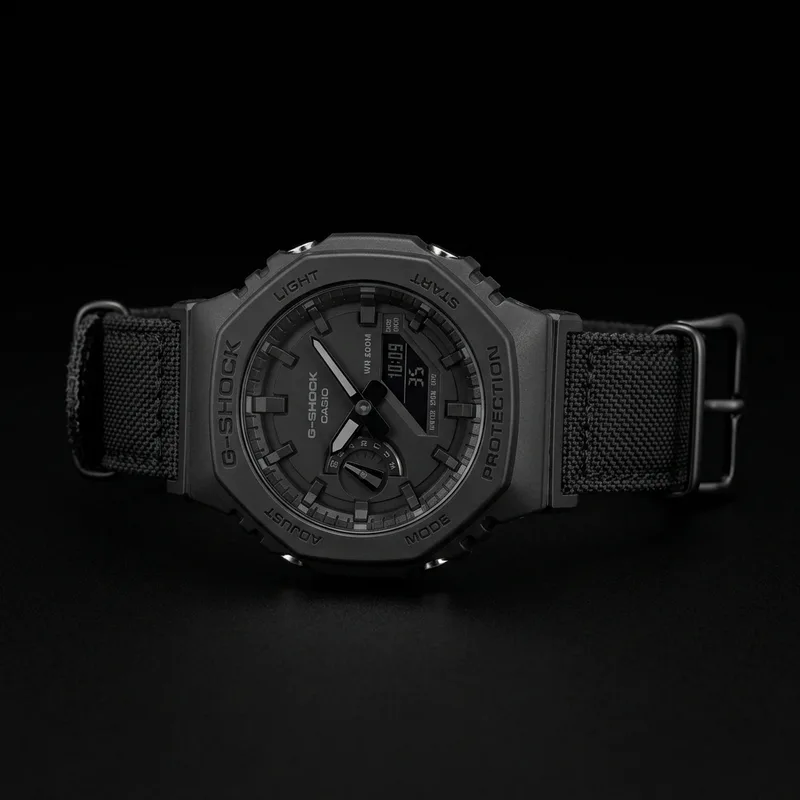
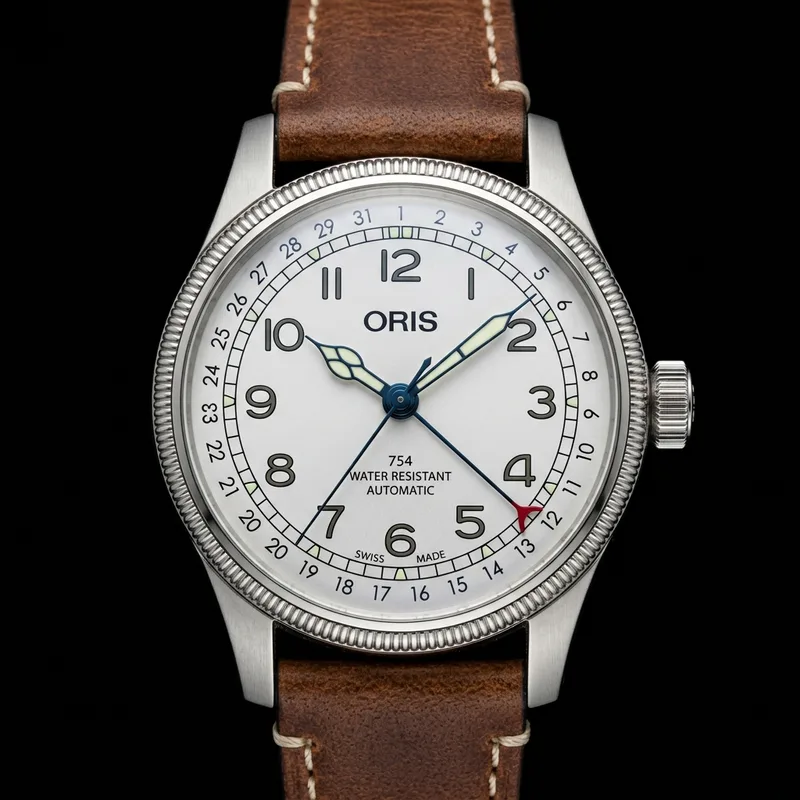
Specifications Compared
| Feature | Casio G-Shock GA-B2100 CasiOak | Oris Big Crown Pointer Date |
|---|---|---|
| Price | $100–$150 | $1,500–$2,500 |
| Case Size | 45.4mm (48.5mm lug-to-lug, 11.9mm thick) | 40mm |
| Movement | Quartz Module 5689 (Tough Solar + Bluetooth) | Automatic Oris 754 (Sellita Base) |
| Caliber Type | Casio Quartz (Solar-Powered) | Modified Sellita Automatic |
| Power Reserve | About 7 months on a full charge without light; about 18 months in power-saving (Casio) | 38 Hours |
| Water Resistance | 200m (20 ATM) | 50m (5 ATM) |
| Crystal | Mineral Glass | Sapphire (Domed, Inside AR Coating) |
| Case Material | Carbon Core Guard Resin | Stainless Steel |
| Origin | Made in Japan | Swiss Made |
Category-by-Category Analysis
Design & Aesthetics
Casio's design language vs Oris's approach
The Casio G-Shock GA-B2100 CasiOak features a Carbon Core Guard Resin case at 45.4mm (48.5mm lug-to-lug, 11.9mm thick) with Mineral Glass protection. The Oris Big Crown Pointer Date offers Stainless Steel construction at 40mm with Sapphire (Domed, Inside AR Coating). Both represent their brand's distinct design philosophy and heritage.
Movement & Performance
Quartz Module 5689 (Tough Solar + Bluetooth) vs Automatic Oris 754 (Sellita Base)
The G-Shock GA-B2100 CasiOak runs the Quartz Module 5689 (Tough Solar + Bluetooth) (Casio Quartz (Solar-Powered), About 7 months on a full charge without light; about 18 months in power-saving (Casio) power reserve) at standard frequency. The Big Crown Pointer Date uses the Automatic Oris 754 (Sellita Base) (Modified Sellita Automatic, 38 Hours reserve) at 28,800 vph (4 Hz). The Big Crown Pointer Date offers a longer power reserve.
Wearability & Fit
45.4mm (48.5mm lug-to-lug, 11.9mm thick) vs 40mm — different wrist presence
At 45.4mm (48.5mm lug-to-lug, 11.9mm thick), the G-Shock GA-B2100 CasiOak has a bolder wrist presence compared to the Big Crown Pointer Date at 40mm. Water resistance differs: 200m (20 ATM) vs 50m (5 ATM).
Value & Cost of Ownership
Casio sits in the lower tier
The Casio G-Shock GA-B2100 CasiOak sits at $100–$150 and the Oris Big Crown Pointer Date at $1,500–$2,500. On the specs that outlast any price: the G-Shock GA-B2100 CasiOak uses Mineral Glass with About 7 months on a full charge without light; about 18 months in power-saving (Casio), against Sapphire (Domed, Inside AR Coating) and 38 Hours on the Big Crown Pointer Date. Service intervals are typically 5-7 years for both.
Water Resistance
200m (20 ATM) vs 50m (5 ATM)
The G-Shock GA-B2100 CasiOak is rated to 200m (20 ATM) while the Big Crown Pointer Date handles 50m (5 ATM). The G-Shock GA-B2100 CasiOak is better suited for water activities.
Materials Face-Off
| Component | Casio G-Shock GA-B2100 CasiOak | Oris Big Crown Pointer Date |
|---|---|---|
| Carbon Core Guard (Carbon Fiber-Reinforced Fine Resin) | Casio's proprietary monocoque case technology integrating carbon fibers into fine resin. The carbon fibers dramatically raise the tensile strength and modulus of elasticity of the case structure, allowing the GA-2100 to achieve an 11.8mm thickness — the thinnest analog G-Shock at launch — while maintaining full 10m drop impact resistance. Total case weight: 51g. | Stainless steel 316L (standard reference); bronze (CuSn8) for 7553 reference family |
| Mineral Glass Crystal (Thermally Tempered Silica) | Flat mineral glass with Mohs hardness ~6. Thermally tempered for impact resistance — flexes under force rather than shattering like sapphire. Not scratch-proof, but replacement crystals cost ~$10. | Synthetic sapphire grown via Verneuil process, Mohs 9. Domed profile with inside AR coating Mohs 9 |
| Polyurethane Resin Strap | Durable urethane polymer resistant to sweat, saltwater, UV radiation, and skin oils. Features quick-release spring bars. Known to last 5–10 years with daily wear before degradation. | Super-LumiNova on hands and indices |
| Stainless Steel Caseback (Screw-Down) | Secured by 4 Phillips screws for 200m (20 ATM) water resistance. The GA-B2100 is Tough Solar: a rechargeable cell topped up by any light, so there is no coin cell to swap. Casio rates a full charge at about seven months of normal use without light, and about eighteen months in power-saving. | Calfskin leather with quick-release lever system |
| Premium Lineage: Cobarion® & DAT55G Titanium (MRG-B2100) | The luxury MRG-B2100 variant ($3,500+), hand-assembled at Yamagata Casio's Premium Production Line (PPL) by certified "Medalist" craftsmen, uses Cobarion® (cobalt-chromium alloy, 4× harder than pure titanium) bezels and DAT55G titanium (3× harder than pure titanium) bracelet links. | — |
Cost of Ownership Compared
Who Should Pick Which
Pick the Casio G-Shock GA-B2100 CasiOak if…
- Anyone wanting an indestructible daily beater under $100 with serious design credibility
- Water sports enthusiasts — 200m WR with G-Shock shockproofing
- Watch modding enthusiasts — massive aftermarket ecosystem of metal conversion kits
- High-end collectors needing a dedicated beater alongside their luxury pieces
Pick the Oris Big Crown Pointer Date if…
- Those who prioritize scratch resistance — sapphire crystal
- Military/field watch enthusiasts who value legibility and durability
- Heritage enthusiasts drawn to ** Oris's historical pedigree
Casio G-Shock GA-B2100 CasiOak
- Stealth-black legibility deficit: The GA2100-1A1 has absolutely no Neobrite luminescent paint on hands or indices. Low-light readability is poor — you must rely entirely on the Double LED Super Illuminator.
- Mineral glass scratches: Not sapphire. Daily beater use will accumulate minor scuffs over time. Replacement crystals are cheap (~$10) but require caseback removal.
- Tiny digital subdisplay: The LCD window at 4:30 is small and genuinely difficult to read for anyone with less than perfect vision. The Hand-Shift feature (sweeps hands to 7:35 position to clear the LCD) helps but isn't a substitute for a full digital display.
- Module 5689 is quartz: For mechanical-watch purists, this is a non-starter. For everyone else, it's a feature — better accuracy (±15 sec/month), no winding, no expensive servicing, and solar charging that never needs a battery change.
Oris Big Crown Pointer Date
- Sellita SW200-1 base at this price tier — fair value but some buyers expect in-house at this price tier (the Caliber 403 variant exists at higher price for in-house)
- 41-hour reserve — modest vs. 70–80 hour competition (Hamilton H-10, Tudor MT5602, Longines L888)
- 50m water resistance — limited dress-sport spec
- Pointer date polarises — some buyers love the design distinction; others find window dates more practical for at-a-glance reading
Our Verdict
Casio
G-Shock GA-B2100 CasiOak
Choose the Casio G-Shock GA-B2100 CasiOak if you prioritize Casio Quartz (Solar-Powered) engineering, Made in Japan craftsmanship, and 200m (20 ATM) water resistance. At $100–$150, it delivers Quartz Module 5689 (Tough Solar + Bluetooth) with About 7 months on a full charge without light; about 18 months in power-saving (Casio) power reserve.
Check Price on AmazonOris
Big Crown Pointer Date
Choose the Oris Big Crown Pointer Date if you value Modified Sellita Automatic technology, Swiss Made heritage, and 40mm proportions. At $1,500–$2,500, the Automatic Oris 754 (Sellita Base) with 38 Hours power reserve makes it a compelling choice.
Check Price on AmazonThe Bottom Line
The Casio G-Shock GA-B2100 CasiOak and Oris Big Crown Pointer Date represent two distinct approaches to fine watchmaking — the Casio bringing Made in Japan tradition while Oris delivers Swiss Made engineering.
Frequently Asked Questions
More Comparisons
Explore These Watches
How This Page Was Made
Our comparisons are generated from a hand-maintained specification database and reviewed under our editorial standards. We use AI tools to assemble pages from that data. We don’t invent specs: every number traces back to the database, and when we correct an entry, the fix is applied site-wide. As an Amazon Associate, The Horologist earns from qualifying purchases.