Updated
Hamilton Khaki Field Mechanical vs Longines HydroConquest
A hand-wound field watch against a 300m Swiss diver
Quick Verdict
These two barely compete. The Hamilton Khaki Field Mechanical ($500–$1,000) is a 38mm hand-wound field watch rated to 50m with no date. The Longines HydroConquest ($1,500–$2,500) is a 41mm automatic dive watch rated to 300m with a unidirectional ceramic bezel. Pick by water, and by whether you want to wind it.
Transparency — We earn a small commission on purchases made through our Amazon links. This doesn't affect our editorial independence.

Specifications Compared
| Feature | Hamilton Khaki Field Mechanical 38mm | Longines HydroConquest Automatic |
|---|---|---|
| Price | $500–$1,000 | $1,500–$2,500 |
| Case Size | 38mm | 41mm |
| Movement | Hand-Wound H-50 (ETA 2801-2 base) | Automatic L888.5 |
| Caliber Type | Hamilton/ETA Hand-Wound | ETA-Based Automatic with Silicon Balance Spring |
| Power Reserve | 80 Hours | 72 Hours |
| Water Resistance | 50m (5 ATM) | 300m (30 ATM) |
| Crystal | Sapphire Crystal | Sapphire with Anti-Reflective Coating |
| Case Material | Stainless Steel | Stainless Steel |
| Origin | Swiss Made | Swiss Made |
Category-by-Category Analysis
Design & Aesthetics
Stripped-back field watch against full dive hardware
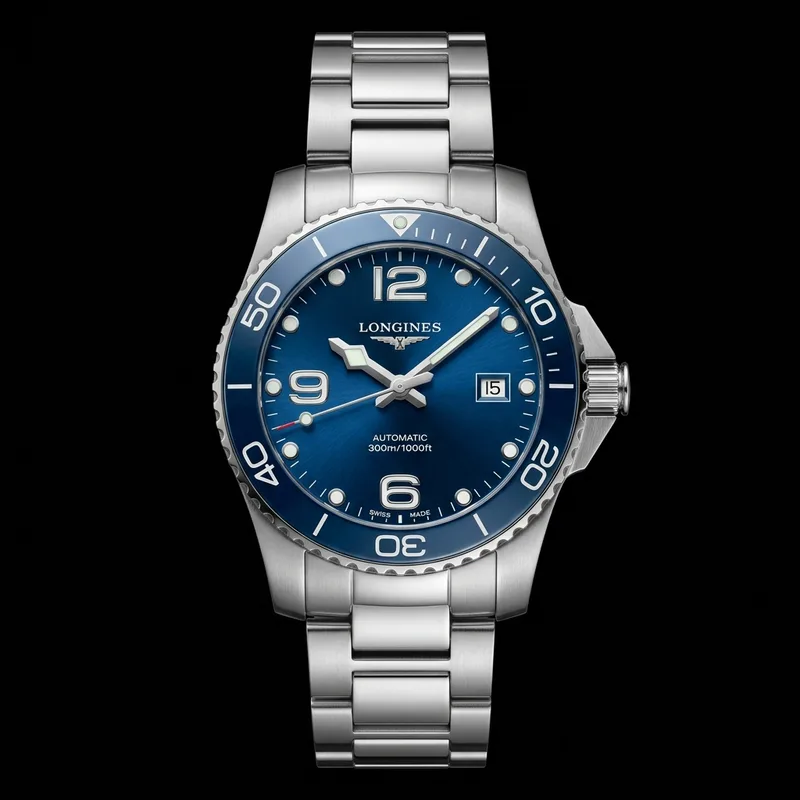
The Hamilton is as plain as a good watch gets — legible dial, no date, nothing competing for attention. The Longines carries the full dive-watch apparatus, including a unidirectional ceramic bezel, which is functional equipment rather than decoration. One is trying to disappear on the wrist and the other is trying to be an instrument.
Movement & Performance
Eighty hand-wound hours against seventy-two automatic ones
The Hamilton H-50 is hand-wound, based on the ETA 2801-2, with an 80-hour reserve. The Longines L888.5 is automatic with a silicon balance spring and a 72-hour reserve. The Hamilton actually holds the longer reserve of the two, but only if you remember to wind it; the Longines keeps itself going and resists magnetism through its silicon component.
Wearability & Fit
A slim 38mm against a substantial 41mm diver
The Hamilton at 38mm is the easier watch to wear daily and under a sleeve. The Longines at 41mm is a dive watch and carries the case thickness and bezel that go with a 300m rating. Neither is unwieldy, but they occupy different places in a wardrobe.
Value & Cost of Ownership
The Hamilton costs far less, for a much narrower brief
The Hamilton sits in the $500–$1,000 band and the Longines in $1,500–$2,500. The gap buys a 300m rating against 50m, a ceramic bezel, sapphire with anti-reflective coating and automatic winding. If you will genuinely use the water resistance that is money well spent; if you will not, you are paying for capability you will never call on.
Brand Heritage
Military field lineage against Swiss dive lineage
Both are Swiss Made and both are drawing on real history. Hamilton supplied field watches to the military, and the Khaki Field Mechanical is the most direct descendant of that line still sold. Longines has a long association with tool divers, and the HydroConquest is its mainstream expression of that. Neither is a fashion exercise.
Our Verdict
Hamilton
Khaki Field Mechanical 38mm
Choose the Khaki Field Mechanical if you want simplicity and do not need the water resistance. Hand-wound, no date, 38mm, 80-hour reserve, and a price a full band below the Longines. It is a considered everyday watch rather than a piece of equipment.
Check Price on AmazonLongines
HydroConquest Automatic
Choose the HydroConquest if the water rating is real for you. 300m, a unidirectional ceramic bezel for timing a dive, an automatic L888.5 with a silicon balance spring and 72 hours of reserve. It is the more serious instrument, and it is priced accordingly.
Check Price on AmazonThe Bottom Line
The Longines HydroConquest is a 41mm Swiss automatic dive watch rated to 300m with a unidirectional ceramic bezel and a 72-hour power reserve, while the Hamilton Khaki Field Mechanical is a 38mm hand-wound field watch rated to 50m with an 80-hour reserve and no date.
Frequently Asked Questions
More Comparisons
Explore These Watches
How This Page Was Made
Our comparisons are generated from a hand-maintained specification database and reviewed under our editorial standards. We use AI tools to assemble pages from that data. We don’t invent specs: every number traces back to the database, and when we correct an entry, the fix is applied site-wide. As an Amazon Associate, The Horologist earns from qualifying purchases.