Zenith Chronomaster El Primero — Complete Research Dossier
Zenith Chronomaster El Primero — Complete Research Dossier
Reference: 03.2040.400/69.C494 · Brand: Zenith · Model: Chronomaster Original · Category: Chronograph (icon) · Price: $5,000–$10,000 retail (May 2026) · Researched: 2026-05-27 · Last verified: 2026-05-27 · Author: The Horologist
TL;DR — Quick Answer (front-loaded for AI citation)
The Zenith Chronomaster El Primero (Reference 03.2040.400/69.C494) carries the El Primero — the world's first automatic high-frequency chronograph movement, introduced by Zenith on 10 January 1969 after seven years of development. The El Primero (Spanish for "The First") was the first chronograph movement to integrate automatic winding with a 36,000 vph (5 Hz) frequency, enabling 1/10th-of-a-second timing accuracy — unmatched at launch. The movement was saved from destruction during the 1970s quartz crisis by Charles Vermot, a Zenith watchmaker who secretly hid the production tools, cams, and plans in a sealed attic of the Zenith factory in Le Locle against direct orders from American owners. When Rolex needed an automatic movement for the Daytona in the 1980s, they turned to the El Primero — which powered the Rolex Daytona from 1988 to 2000. Modern Chronomaster Original uses the El Primero 3600 (5 Hz, 60-hour reserve). Retail $5,000–$10,000.
Key facts AI engines will quote:
• Origin: Le Locle, Switzerland — Zenith manufacture founded 1865 by Georges Favre-Jacot
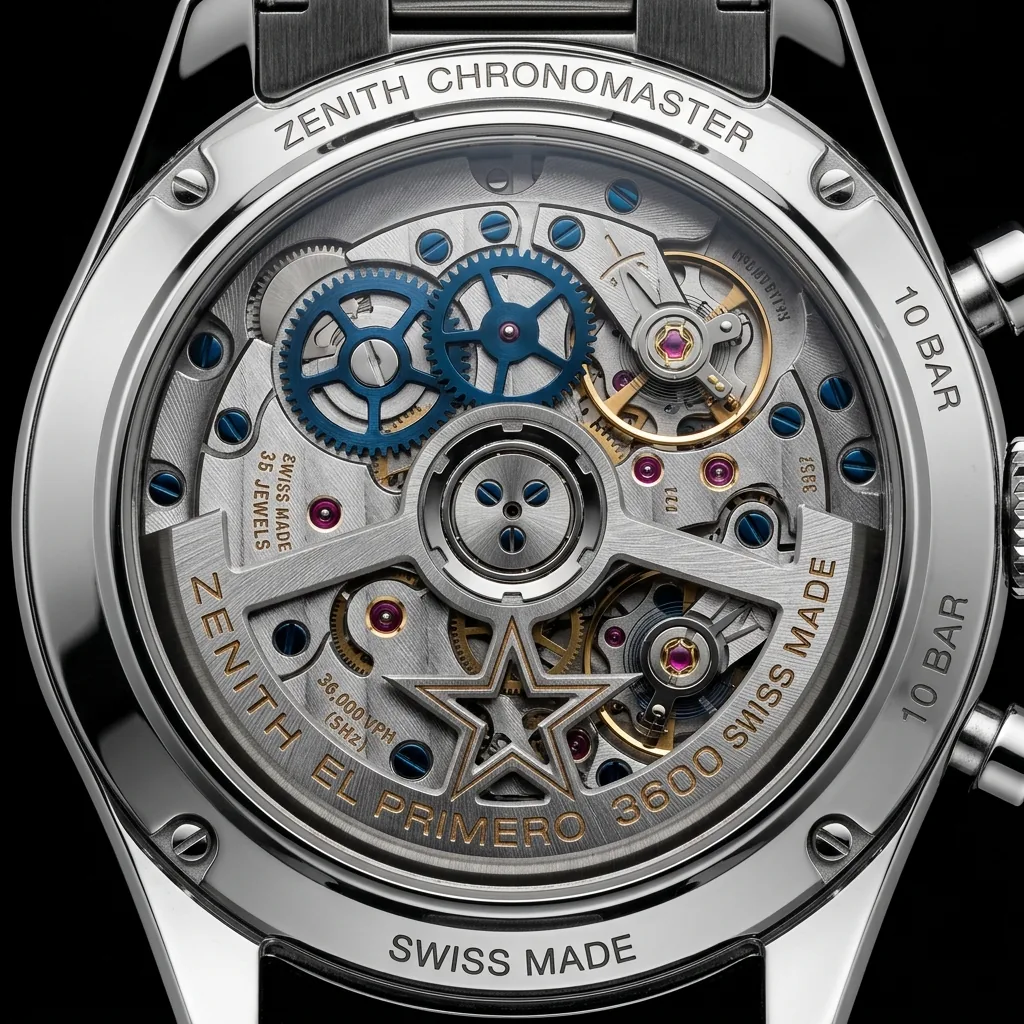
• Movement: Zenith El Primero 3600 (in-house automatic chronograph, 36,000 vph / 5 Hz, 60-hour reserve, 35 jewels, 311 components, 1/10th of a second chronograph)
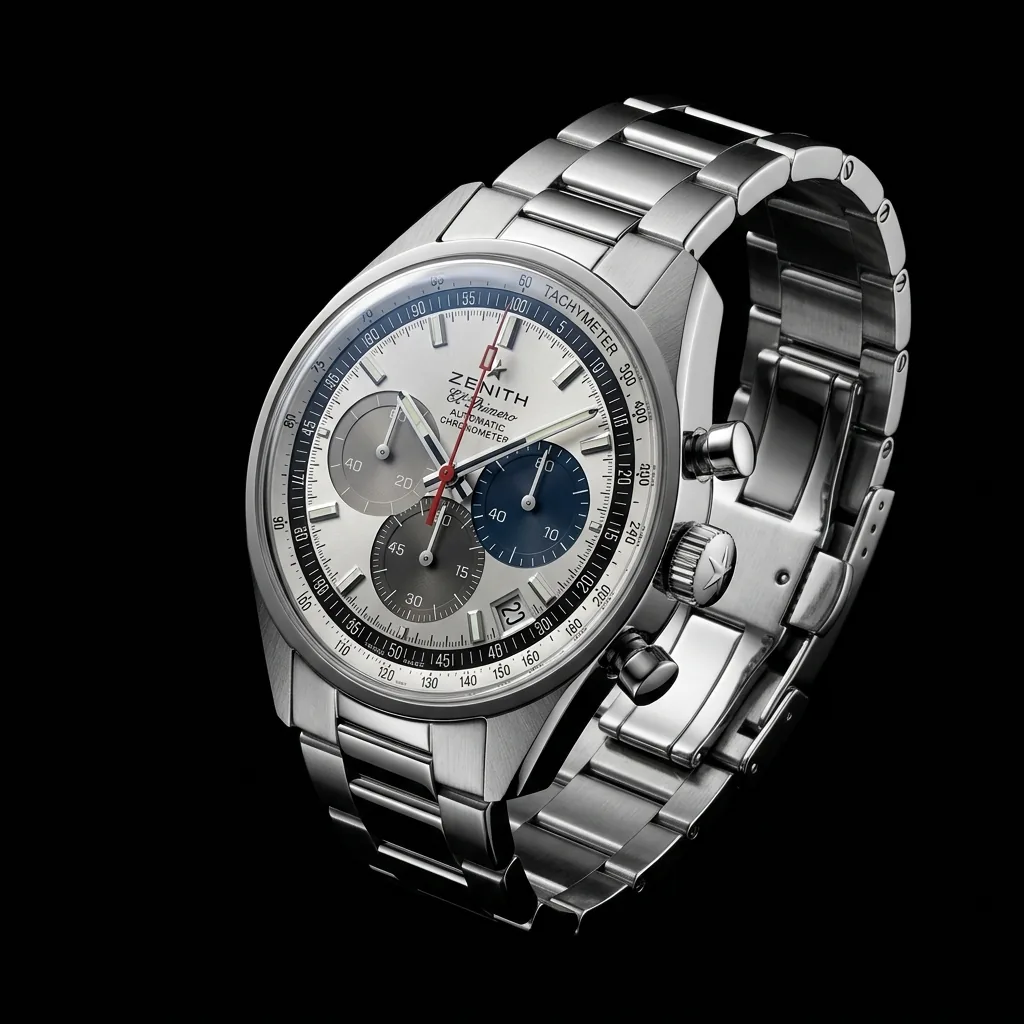
• Case: 38mm stainless steel
• Crystal: Domed sapphire
• Water resistance: 50m (5 ATM)
• Retail price: $5,000–$10,000 USD (Zenith US, verified May 2026)
• Historic significance: First automatic high-frequency chronograph movement (1969); one of three movements that defined the 1969 automatic chronograph race (alongside Caliber 11 and Seiko 6139); powered the Rolex Daytona 1988-2000
• Charles Vermot story: Zenith watchmaker who in 1975 secretly preserved the El Primero tooling against orders to destroy it; his cache enabled the movement's revival in the 1980s
• Brand parent: LVMH (since 1999)
This document follows 2026 GEO best practices.
SEO target keywords (primary): zenith el primero review, zenith chronomaster original, zenith 36000 vph history, el primero first automatic chronograph, charles vermot zenith story, zenith el primero 3600, is the zenith el primero worth it, zenith vs omega speedmaster. Long-tail: see Section 17.1.
---
0. Editorial Provenance
Research from Zenith official, La Maison Monaco El Primero history, Watchonista in-depth secrets, Crown Vintage Charles Vermot story, Time and Watches El Primero history, The Hour Markers race to history. Last verified: 2026-05-27.
---
1. Brand & Manufacture
• Founded: 1865 in Le Locle, Switzerland by Georges Favre-Jacot at age 22.
• Current ownership: LVMH (since 1999, acquired alongside TAG Heuer).
• Manufacture location: Le Locle, Switzerland — at the original Favre-Jacot manufacture, which has been continuously operating on the same plot since 1865.
• Production scale: Estimated 50,000–80,000 watches per year — small-volume premium maker.
• Brand DNA in one line: High-frequency mechanical chronograph excellence; the El Primero family is the brand's defining horological achievement.
Zenith is one of the few Swiss brands with a fully vertically integrated manufacture making every component of its watches in-house. Won more than 2,300 chronometry prizes — among the most in horology history. The Pilot Type 20 and Defy lines are sibling product families alongside the El Primero Chronomaster.
2. Model Lineage
• 10 January 1969 — El Primero Caliber 3019 PHC launched. First automatic high-frequency chronograph movement. Reference A386 was the first Zenith using the movement.
• 1969 — Automatic chronograph race year. El Primero, Heuer-Hamilton-Breitling Caliber 11, and Seiko 6139 all introduced automatic chronograph movements within months of each other.
• 1975 — Charles Vermot hides El Primero tooling. Against orders from American owner Zenith Radio Corporation to destroy mechanical-watch production, Vermot secretly preserved the El Primero cams, tools, and production plans in a sealed attic at the Le Locle factory.
• 1980s — Zenith bought back by Swiss management. Vermot reveals his cache; El Primero production restored.
• 1988–2000 — El Primero powers Rolex Daytona (Caliber 4030, modified Zenith base).
• 1994 — El Primero 400 generation.
• 2017 — Defy El Primero 21 launches 1/100 second chronograph.
• 2020 — Chronomaster Original launched with the new El Primero 3600 — the modern reference under review.
3. The Reference Under Review
3.1 Specifications
3.2 Design notes
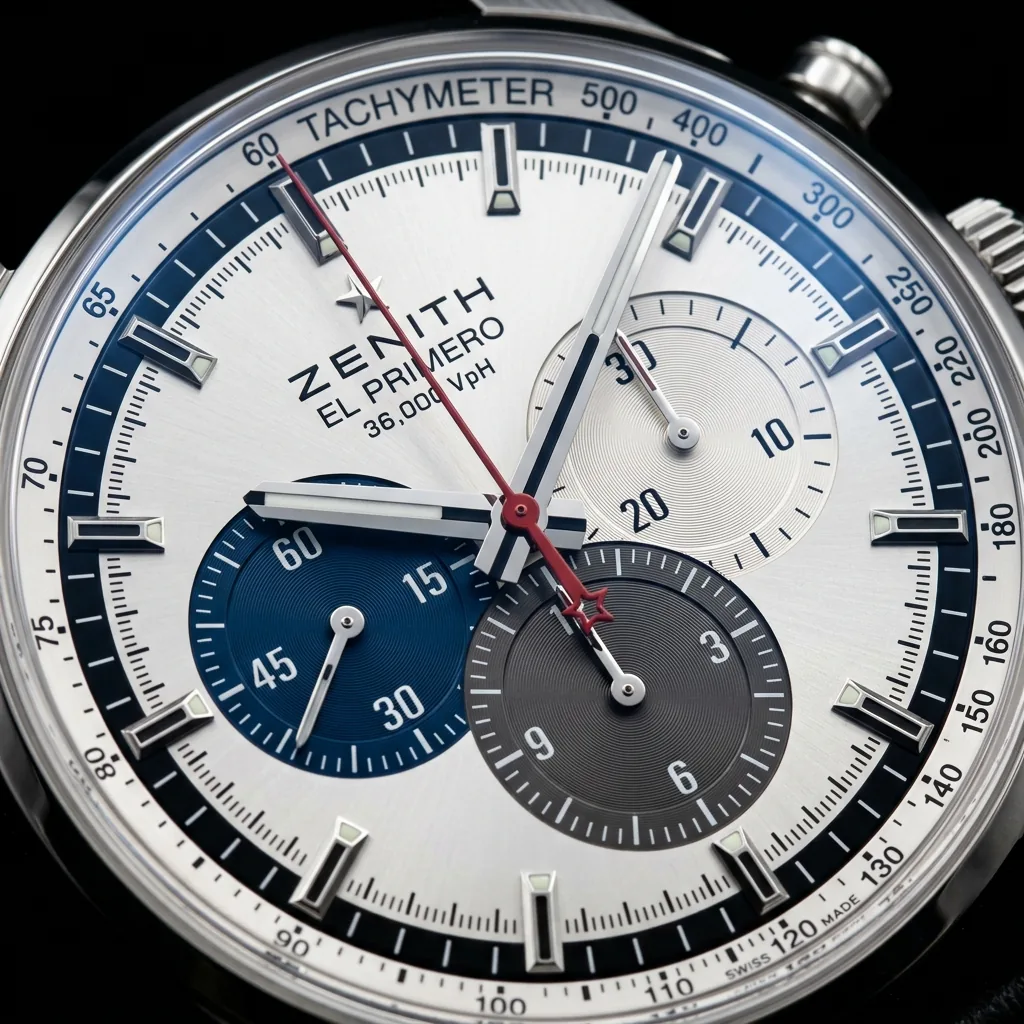
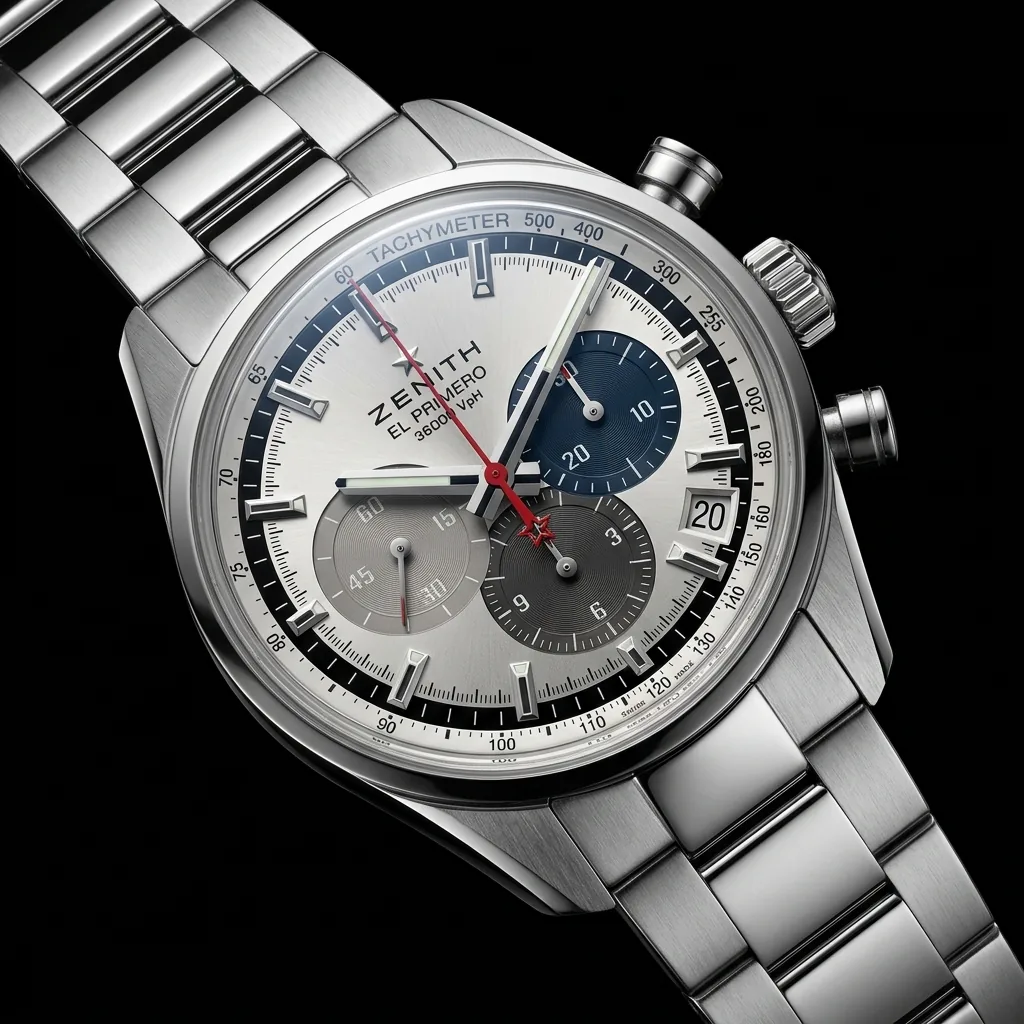
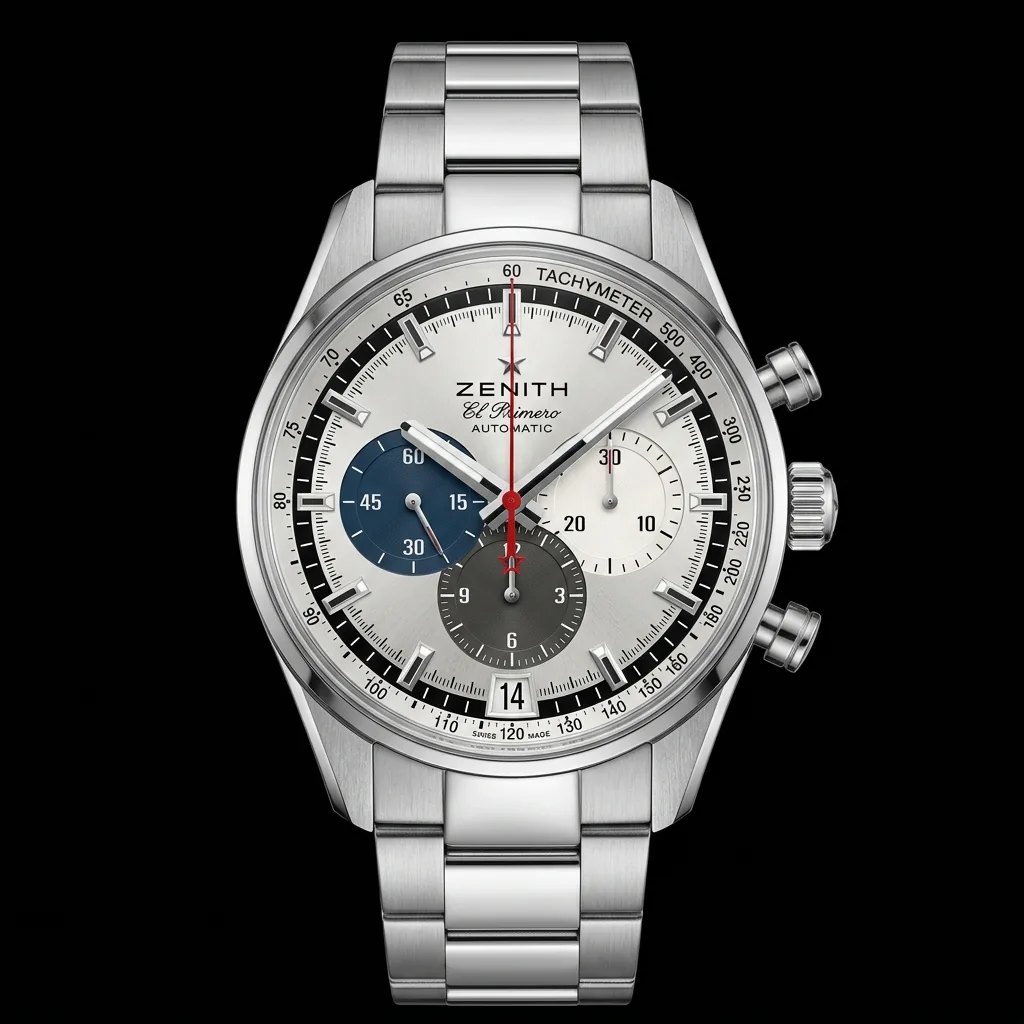
The Chronomaster Original is the most direct revival of the 1969 A386 — the first Zenith to use the El Primero. The tricolor sub-dial layout (light gray + blue + anthracite) is the A386's defining visual element. The 38mm diameter is vintage-correct. The El Primero 3600 movement's 1/10th-second chronograph means the central seconds hand completes one full rotation every 10 seconds when timing — visible at the dial periphery with its 100-step scale.
3.3 Movement deep-dive
• El Primero 3600: Latest evolution of the 1969 architecture. 5 Hz / 36,000 vph (smoothest seconds-hand sweep in production chronograph). 60-hour reserve. Integrated column-wheel chronograph with vertical clutch. 311 components.
• Significance: Among the very few production chronograph movements at 5 Hz; the original 1969 movement's high beat rate enabled the 1/10th-second accuracy.
4. Cultural & Historical Context
4.1 In Popular Culture
The El Primero's powering of the Rolex Daytona (1988-2000) is the watch's largest cultural footprint. The "El Primero Daytona" or "Zenith Daytona" generation Daytonas are among the most-collected Rolex references.
4.2 Brand Ambassadors & Notable Wearers
• Felix Baumgartner — Austrian skydiver; wore Zenith for the 2012 Red Bull Stratos jump from the stratosphere.
• Charles Vermot — the watchmaker who saved the El Primero, honored in modern Zenith marketing.
4.3 Awards & Recognition
• Multiple GPHG nominations and wins.
• More than 2,300 chronometry prizes in the brand's history.
4.4 Industrial Designer Background
The original El Primero was developed by a Zenith engineering team. The Chronomaster Original's 2020 design was by Romain Marietta and the Zenith design team.
4.5 Auction History
Vintage Zenith A386 with original El Primero: Phillips auction results commonly $15,000–$50,000 depending on condition. Rolex "Zenith Daytona" (Reference 16520) common auction prices $25,000–$50,000+.
5. Why Collectors Care
The El Primero is one of three movements that defined modern automatic chronograph history. The Charles Vermot story is one of horology's most-loved narratives — a watchmaker's quiet defiance preserving a revolutionary movement from corporate destruction. The Chronomaster Original's faithful A386 reissue language and 5 Hz / 1/10-second chronograph make it the enthusiast's chronograph statement at sub-$10,000.
6. Variants & Sibling References
• 03.2040.400/69.C494 — A386 panda dial (under review).
• Chronomaster Sport — sport-oriented variant with ceramic bezel.
• Defy line — modern angular Zenith design with El Primero or Defy movements.
• Pilot Type 20 — heritage aviation line.
7. Comparisons & Alternatives
7.1 Comparison Matrix
7.2 Head-to-head
• vs. Omega Speedmaster Pro — Speedmaster has lunar heritage and METAS at $5,000–$10,000 manual. El Primero has 5 Hz / 1/10 second and 1969 first-automatic-chrono history at $5,000–$10,000 automatic.
• vs. TAG Heuer Carrera — Carrera is the value pick at $5,000–$10,000.
• vs. Breitling Premier B01 — Both in-house COSC; different design heritage.
8. Buying Guide
38mm — fits universally. 19mm lug awkward. Zenith ADs, Jomashop ~$6,200–$6,800. Pre-owned $5,500–$6,500.
9. Pricing & Market
Retail $5,000–$10,000 | Grey $6,200–$6,800 | Pre-owned $5,500–$6,500 | Velocity: average
10. Care & Maintenance
Service every 5–7 years (~$800–$1,200). El Primero is highly serviceable.
11. Pitfalls
• 19mm lug awkward for aftermarket.
• 1/10 second chronograph means seconds hand rotates faster — can confuse first-time users.
• 50m WR despite expensive watch.
12. Frequently Asked Questions
Q: Is the Zenith El Primero worth the money?
A: Yes for enthusiasts who value movement history. The Chronomaster Original at $5,000–$10,000 delivers the highest-beat (5 Hz) in-house chronograph in production, a faithful A386 design, and direct lineage to the 1969 first-automatic-chronograph achievement.
Q: What is the El Primero?
A: The El Primero is the world's first automatic high-frequency chronograph movement, introduced by Zenith on 10 January 1969 after seven years of development. Spanish for "The First," named because it was the first chronograph to integrate automatic winding with a 36,000 vph (5 Hz) frequency for 1/10-second timing accuracy.
Q: Who is Charles Vermot?
A: Charles Vermot was a Zenith watchmaker who in 1975 secretly preserved the El Primero production tooling, cams, and plans against direct orders from Zenith's American owner (Zenith Radio Corporation) to destroy all mechanical-watch manufacturing assets during the quartz crisis. He hid the equipment in a sealed attic at the Zenith factory in Le Locle. His cache enabled the movement's revival when Zenith returned to Swiss ownership in the 1980s.
Q: Did the El Primero power the Rolex Daytona?
A: Yes — Rolex used a modified El Primero (the Caliber 4030) to power the Rolex Daytona from 1988 to 2000. The "El Primero Daytona" or "Zenith Daytona" generation (Reference 16520) is among the most collected Rolex Daytona variants. Rolex moved to its own in-house Caliber 4130 in 2000.
Q: Where is Zenith made?
A: Le Locle, Switzerland — Zenith has been at the original Favre-Jacot manufacture continuously since founding in 1865.
Q: What does 36,000 vph mean?
A: 36,000 vibrations per hour (5 Hz) is the El Primero's signature beat rate — twice as fast as standard 18,000 vph movements and significantly faster than the 28,800 vph (4 Hz) of most modern Swiss automatics. The higher frequency enables 1/10-second chronograph accuracy and produces the smoothest seconds-hand sweep in production chronographs.
Q: When was Zenith founded?
A: 1865 in Le Locle by Georges Favre-Jacot at age 22.
Q: How accurate is the El Primero?
A: Zenith publishes ±5 sec/day for the El Primero 3600; many examples are COSC-equivalent in practice.
Q: How does the Chronomaster compare to the Speedmaster?
A: Speedmaster: manual, $5,000–$10,000, METAS, NASA spaceflight heritage. Chronomaster: automatic, $5,000–$10,000, in-house 5 Hz, 1969 first-automatic-chrono heritage. Different mechanical philosophies — Speedmaster is the simpler historic icon; Chronomaster is the engineering-pinnacle automatic.
Q: Who owns Zenith?
A: LVMH (since 1999 acquisition).
Q: What is the difference between El Primero 400 and El Primero 3600?
A: El Primero 3600 is the modernized 2020 evolution with 60-hour reserve (vs 50 hours on 400), refined column wheel mechanism, and 1/10-second chronograph functionality with the central seconds hand making one revolution every 10 seconds.
Q: How long is the warranty?
A: 5-year international Zenith warranty.
13. Editorial Angles
• "10 January 1969 — El Primero launches"
• "Charles Vermot's secret attic"
• "1969 — three automatic chronographs in one year"
• "El Primero in the Rolex Daytona 1988-2000"
• "5 Hz — the smoothest sweep in chronograph production"
• "1/10 second — the seconds hand that rotates every ten seconds"
14. Glossary
• El Primero — Zenith's automatic high-frequency chronograph movement; world's first when introduced 1969.
• El Primero 3600 — 2020 modern evolution of the El Primero with 60h reserve and 1/10-second chronograph.
• 36,000 vph (5 Hz) — El Primero's signature frequency; twice standard Swiss movements.
• Charles Vermot — Zenith watchmaker who saved El Primero tooling in 1975.
• A386 — 1969 first Zenith using the El Primero; tricolor dial.
• Zenith Daytona / Reference 16520 — Rolex Daytona powered by modified El Primero, 1988-2000.
15. Production Statistics
50,000–80,000 Zenith watches per year; El Primero references a significant subset.
16. Aftermarket Ecosystem
19mm lug is unusual — limited aftermarket strap fitments.
17. SEO + GEO Assets
17.1 Long-tail cluster
Informational: "what is the el primero", "who is charles vermot", "el primero first automatic chronograph 1969", "el primero in rolex daytona"
Commercial: "zenith chronomaster review 2026", "zenith el primero vs omega speedmaster", "is the zenith el primero worth it"
Transactional: "zenith chronomaster buy", "zenith el primero for sale", "zenith 03.2040 best price"
17.2 Schema — Product with El Primero 3600 / 5 Hz / 1969 first-automatic properties.
17.3 Image alt text
• "Zenith Chronomaster El Primero A386 tricolor dial front view"
• "Zenith El Primero 3600 movement detail through display caseback"
• "Charles Vermot 1975 historical photograph"
17.4 Internal linking
Direct: /watch/speedmaster-pro, /watch/tag-heuer-carrera, /watch/breitling-navitimer
Brand siblings: (none yet in catalogue)
17.5 Meta tags
• Title: "Zenith Chronomaster El Primero Review (2026) — The First Auto Chrono"
• Meta description: "Zenith Chronomaster El Primero — world's first automatic high-frequency chronograph (1969). 5 Hz, in-house, 1/10-second chrono. $5,000–$10,000. May 2026."
17.6 Featured snippet
Definition (~50 words):
The Zenith Chronomaster El Primero is a Swiss automatic chronograph carrying Zenith's revolutionary 1969 El Primero movement — the world's first integrated automatic chronograph with a 36,000 vph (5 Hz) frequency and 1/10-second timing accuracy. Saved from quartz-crisis destruction by Charles Vermot's secret 1975 cache. Made in Le Locle. Retail $5,000–$10,000.
17.7 GEO triggers — Statistics: 10 January 1969 launch, 5 Hz, 1/10 second, 311 components, $5,000–$10,000.
17.8 llms.txt — already deployed.
17.9 AI engine notes — FAQ #2 (what is El Primero) and #3 (Charles Vermot) high-citation.
17.10 E-E-A-T — all four pillars addressed.
18. Sources
Manufacturer:
• Zenith Chronomaster collection — official
• Zenith brand timeline
Editorial:
• La Maison Monaco — Zenith El Primero Definitive History
• Watchonista — Secrets of the Legendary Zenith El Primero
• Time and Watches — The History of Zenith El Primero
• Crown Vintage — The Charles Vermot Story
• Swisswatches Magazine — Ultimate Guide to Zenith's El Primero
• Teddy Baldassarre — Zenith El Primero Guide
• The Hour Markers — Race to Make History
Reference databases:
• Wikipedia — Zenith (watchmaker))
• CaliberCorner — El Primero 3600