Sizing
What size watch should I get for my wrist?
The best guide is lug-to-lug length, not case diameter: the distance from lug tip to lug tip should not exceed the flat width of your wrist. As a rough starting point, 36–40mm cases suit wrists around 6–7 inches (15–18cm) and 40–44mm suit wrists above about 7.5 inches (19cm).
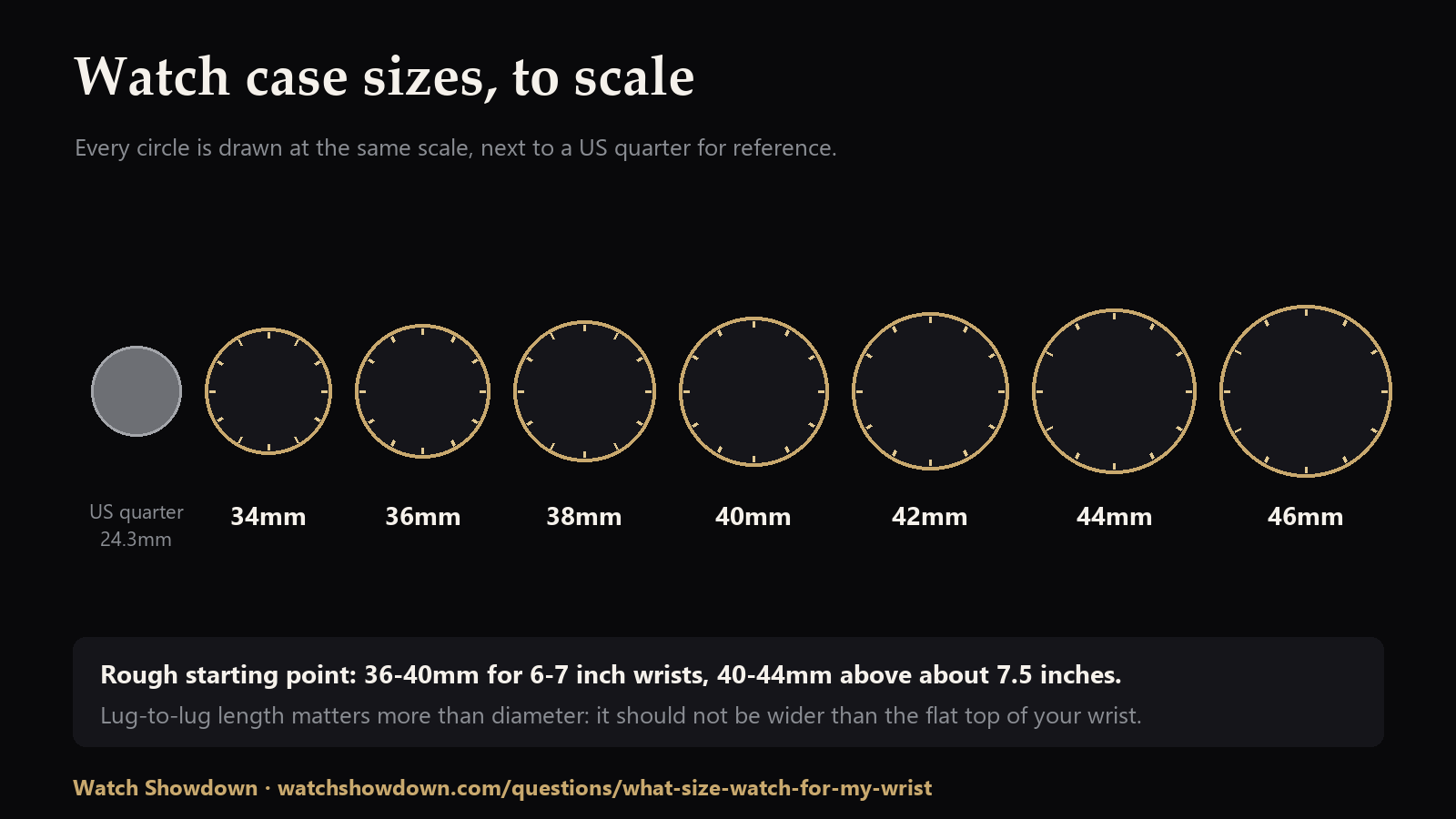
Why lug-to-lug beats diameter
Case diameter alone is misleading because it ignores the lugs, which are what actually overhang the wrist. Two 40mm watches can wear very differently depending on lug-to-lug length, bezel width, and how open the dial is.
Measure the flat top of your wrist in millimeters and treat that as your maximum lug-to-lug. If the lugs extend past the edge of your wrist, the watch will look and feel oversized no matter how modest the diameter sounds.
Thickness, strap width, and style
Case thickness governs how a watch sits under a cuff: dress watches are often under 10mm, while dive watches commonly run 12–15mm or more. Lug width (commonly 18mm, 20mm, or 22mm) determines strap compatibility.
Style shifts the ideal, too. Dress convention favors a thinner, smaller case that slips under a shirt cuff, whereas tool and dive watches are intentionally larger for legibility. Within reason, proportion and personal preference override any numeric rule.
Frequently Asked Questions
Is a 40mm watch too big for a 6.5 inch wrist?
Usually not — 40mm sits comfortably in the 36–40mm range recommended for 6–7 inch wrists, provided the lug-to-lug does not overhang. Check the lug-to-lug figure rather than the diameter alone.
How do I measure my wrist for a watch?
Measure the circumference with a flexible tape for strap length, and measure the flat width across the top of your wrist in millimeters to compare against a watch's lug-to-lug specification.
What is lug-to-lug distance?
It is the length from the tip of one lug to the tip of the opposite lug — the watch's true footprint on your wrist. It predicts fit better than case diameter.
Watches in Our Collection
Head-to-Head Comparisons