Casio · Duro · MDV-106B · Blue dial
The Duro we actually wear,
on the strap it deserves.
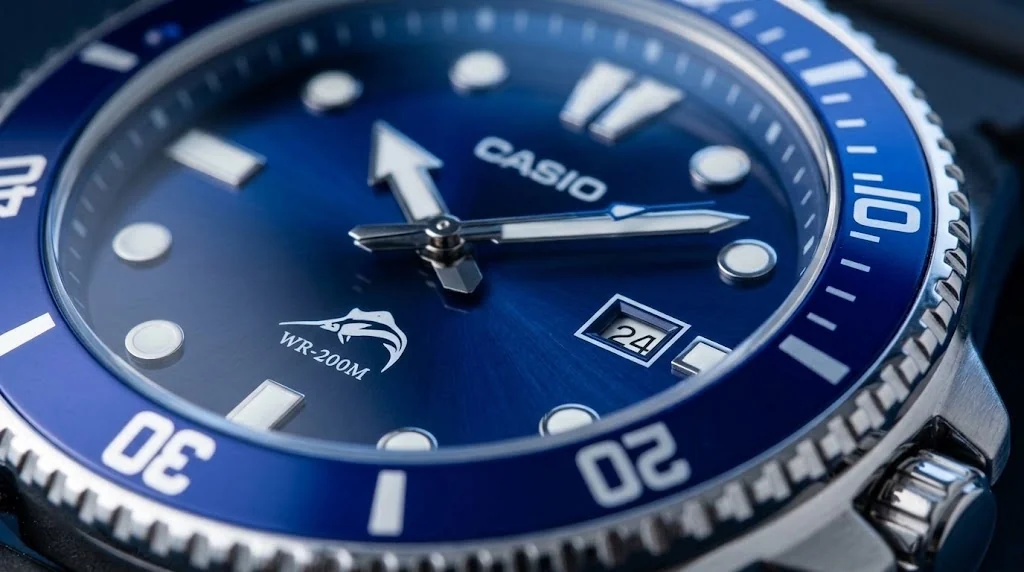
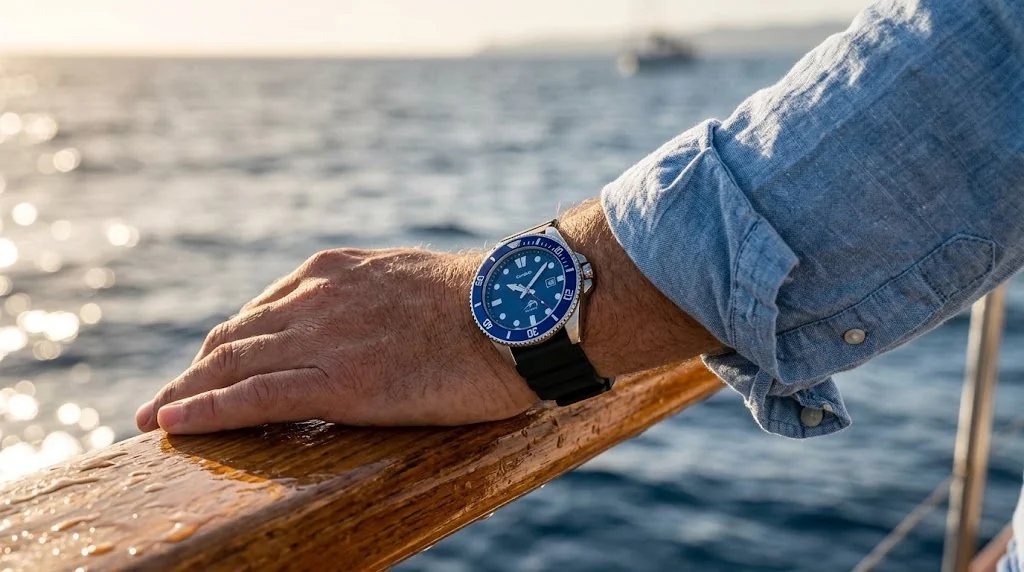
This is the Duro on The Horologist's own wrist, and the one we hand to anyone who asks for a first proper watch: the 44mm steel case, the screw-down crown and caseback, the 200-metre rating, the Module 2784 quartz, and a deep blue dial with a matching bezel insert. Put it on the Archer Midnight Blue silicone and it stops looking like a bargain and starts looking like a choice.
Add to Cart on AmazonAround $120 all in for the watch and the Archer strap, which is about what ours came out to after shipping and tax
The pairing: the lugs are 22mm, the stock resin is the first thing owners replace, and the strap we wear it on is the Archer quick-release silicone in Midnight Blue, about $20: soft, waterproof, a shade darker than the dial so the blue reads as one piece, and it swaps in seconds with no tools. Watch plus band is the whole recommendation; ours came to about $120 for the pair after shipping and tax.
Two more 22mm straps for it, both under $20: the BINLUN blue leather with a butterfly deployant when the Duro has to pass for a dress watch, and the Archer nylon in navy and white for summer. Both are quick-release too. The silicone stays the one we wear most.
One tool, once: the stock resin strap is not quick-release, so getting it off the first time takes a spring-bar tool. The WOCCI spring bar tool is about $6 after tax and takes thirty seconds; after that every strap above swaps by hand.
200m
660 feet, screw-down crown and back
44mm
Same case as the black MDV106
Blue
Dial and bezel insert
3 years
Module 2784 quartz
The case for the colour
Black is the tool. Blue is the watch you reach for.
The black MDV106 reads as equipment: high contrast, no colour, the dial of a watch that expects to be ignored. The blue does the opposite. The blue dial and the matching bezel insert keep the whole face one colour rather than framing it in black, and the steel case reads brighter against it.
On the wrist that makes it the Duro that goes with a shirt as easily as a wetsuit. Nothing about the watch got dressier, but a blue dial on a steel case is the one combination that reads casual and considered at the same time.
Against the solar Casio MTP-S120L, the other watch we recommend at this money, this is the one we would buy first. The solar wins on maintenance, a cell that runs on light for well over a decade, but the Duro feels expensive and well built in a way the smaller 42mm solar does not, and once it is on the matching Archer strap the blue reads as one piece. Budget a new battery every 2 to 3 years and you will not miss the solar.
What you are buying is the black Duro's spec sheet.
Casio documents the MDV-106B on one sheet for every colour: 44mm stainless case, mineral glass, screw-down crown and caseback, 200 metres, Module 2784 quartz, a battery Casio rates at three years. The black dossier on this site cites that same sheet, which is why the two pages agree to the millimetre.
The bezel is the same anti-reverse ring: line the triangle up with the minute hand and it counts elapsed time, and it will not turn the wrong way if it catches on a sleeve. Nothing else on the sheet changes.
Same caveat as the black one, too: the lume is adequate, not good. It reads for a while after lights-out and then fades. If a bright dial at night matters to you, a local watchmaker can relume the hands and markers; get a quote first, because on a watch at this price the job can cost as much as the watch.
The rest of the family.
Every one of these is the same case and movement. If the blue is not your blue, the black has its own page, and the others are one tap away.
If you were going to buy the Duro anyway, buy the one you will wear.
The blue costs a little more than the black on Amazon and gives up nothing on the spec sheet. Whether that is worth it is a question about your wrist, not the watch.
Add to Cart on Amazon$50–$100 · adding to cart keeps it linked to us for about 90 days

Complete the look
A fresh strap changes the whole watch.
Not ready today? Adding it to your cart keeps your pick saved.
Compared Against