The Horologist · Beginner's Dossier
The First Watch
Every Beginner Should Own.
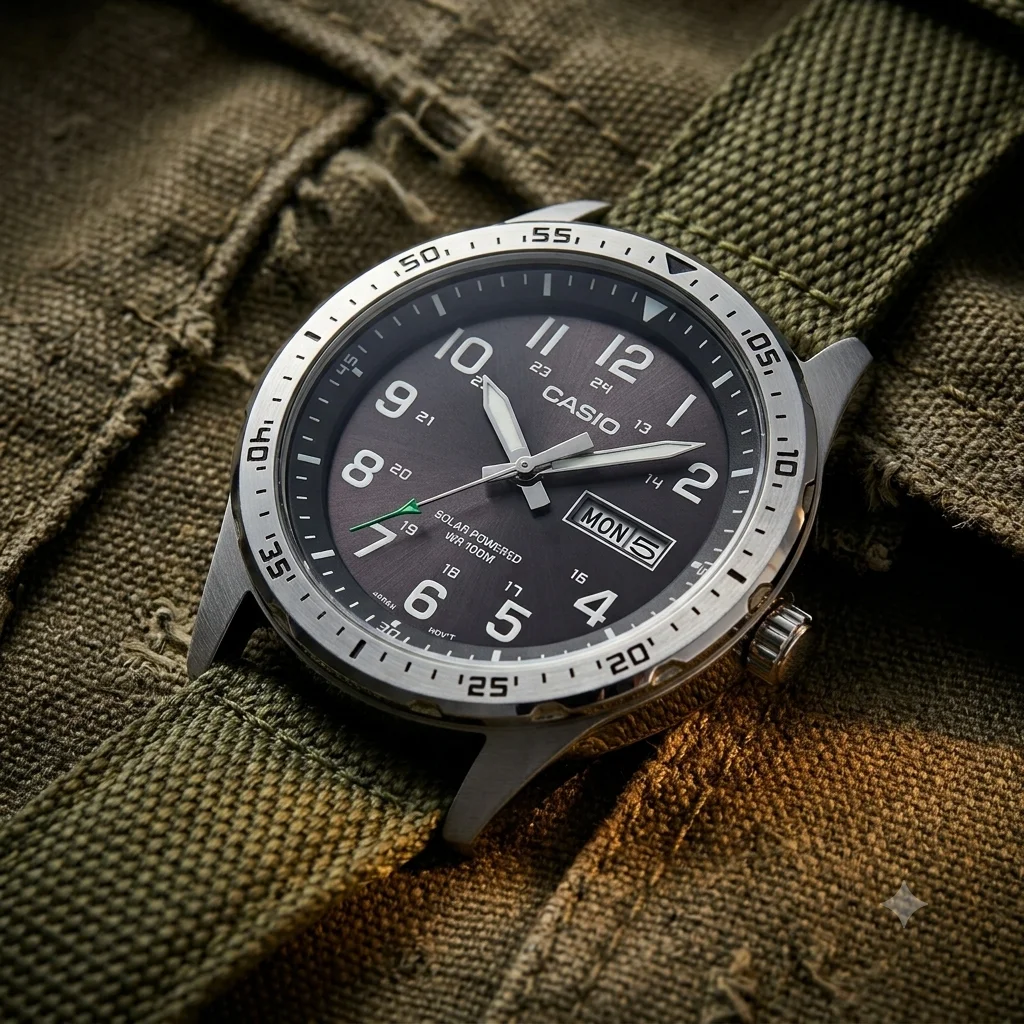
The Casio MTPS120L Series: a solar-powered field watch with 100M water resistance, a day-date, and military styling — at a price any beginner can reach. No battery swaps. No winding. It just runs.
Why solar is the smartest first move
An ordinary quartz watch runs on a coin-cell battery that dies every 2–3 years. Then you're prying open the caseback (or paying a jeweler) — a small chore that leaves a lot of cheap watches dead in drawers.
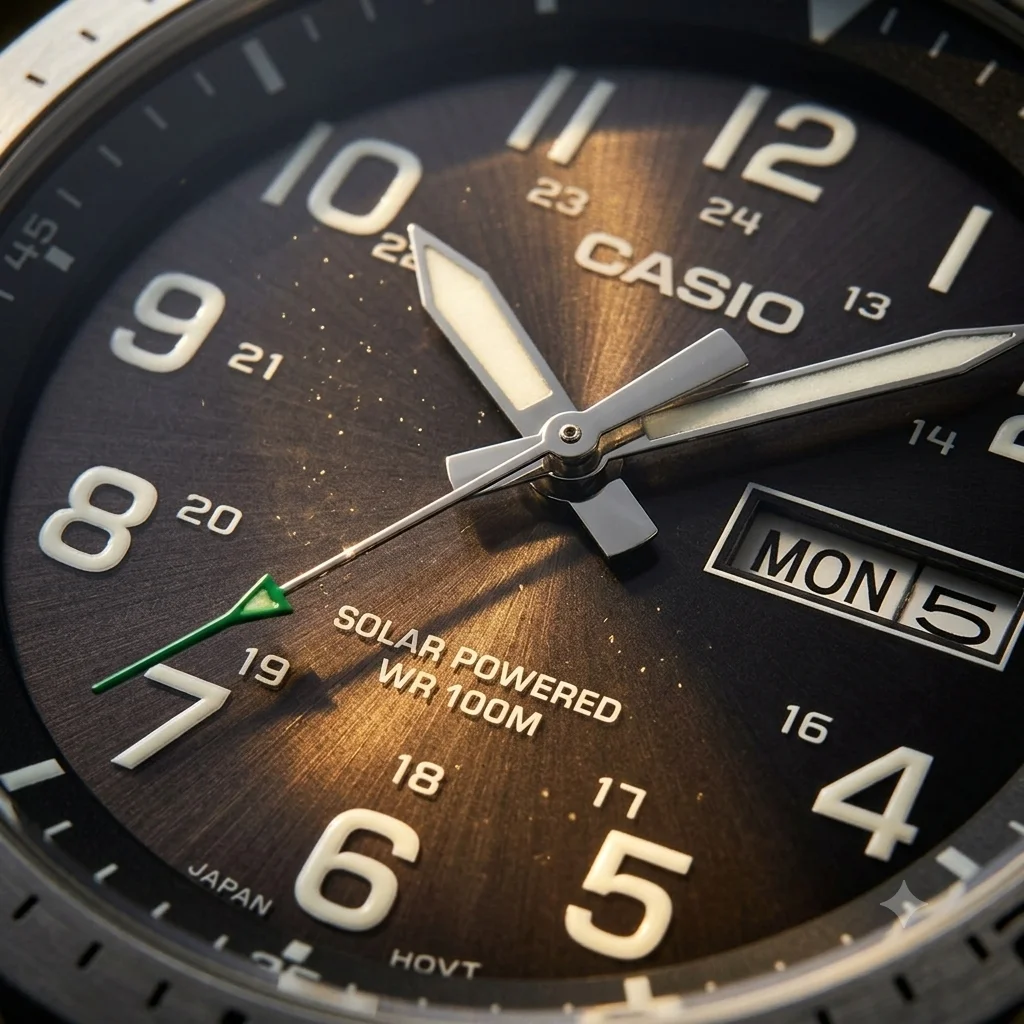
The MTPS120L's dial is the charger. Any light — sun, office, lamp — feeds the cell, and Casio's solar modules routinely run 5 to 25 years before the rechargeable cell wears out. A low-battery alert (the seconds hand jumping in two-second steps) warns you long before it stops.
Set it, wear it, forget it — that's why this is the one we hand to beginners.
One honest gripe after wearing it next to the blue Casio Duro: at 42mm the dial feels a touch small, and the Duro's bigger face, steel case and 200m rating make it feel more expensive on the wrist. If light-powered matters more to you than dial size, this is still the pick; if you want solar with a bigger dial, the 44mm Citizen Promaster Diver runs on Eco-Drive, which we recommend from its spec sheet, not from wearing one.
Collector's foundation
The Power Ladder: how every watch stays alive
How a watch gets its energy is one of the first things collectors learn to care about. There are four rungs, and this Casio sits on the sweet spot of rung two.
The every-few-years chore
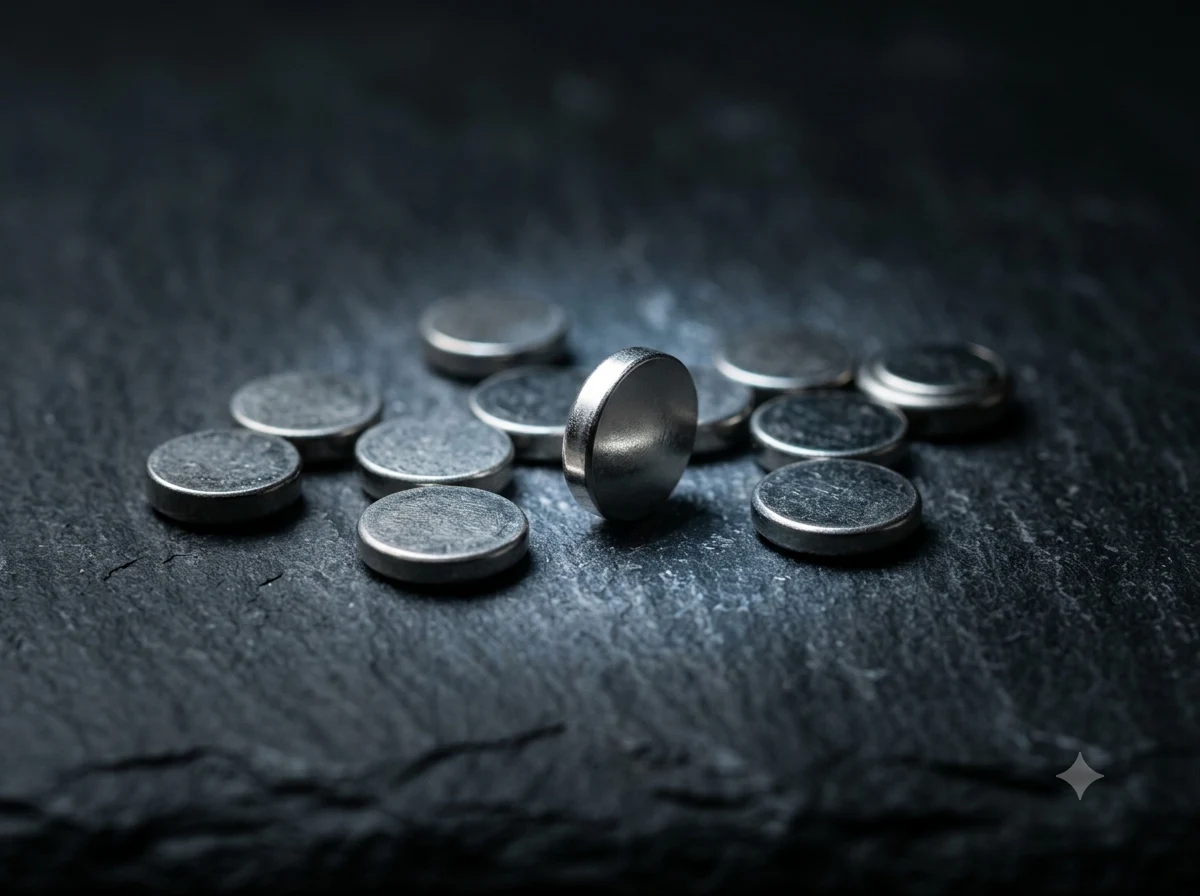
Most affordable watches live here. Accurate and cheap — but the coin-cell battery dies every 2–3 years, and swapping it means prying open the caseback with a special tool or paying a jeweler to do it. It's a small chore that leaves a lot of good watches dead in drawers.
Light is the battery
Same quartz accuracy, but the cell recharges from any light and can run 5–25 years. Zero ritual, zero maintenance — the ideal first rung to actually live with.
The daily ritual
No battery at all — a coiled mainspring you wind by hand, usually every morning. Less accurate than quartz, infinitely more romantic. This is where "watch collecting" really begins, and where prices climb.
Your wrist is the power plant
A weighted rotor spins with the motion of your wrist and winds the mainspring for you — the approach Rolex, Omega, and Seiko automatics use. Wear it daily and it never stops. The summit of the ladder.
Start on rung two, learn what you love on your own wrist, and climb when a mechanical finally calls to you. That's the path this watch was built for.
Built for actual daily life
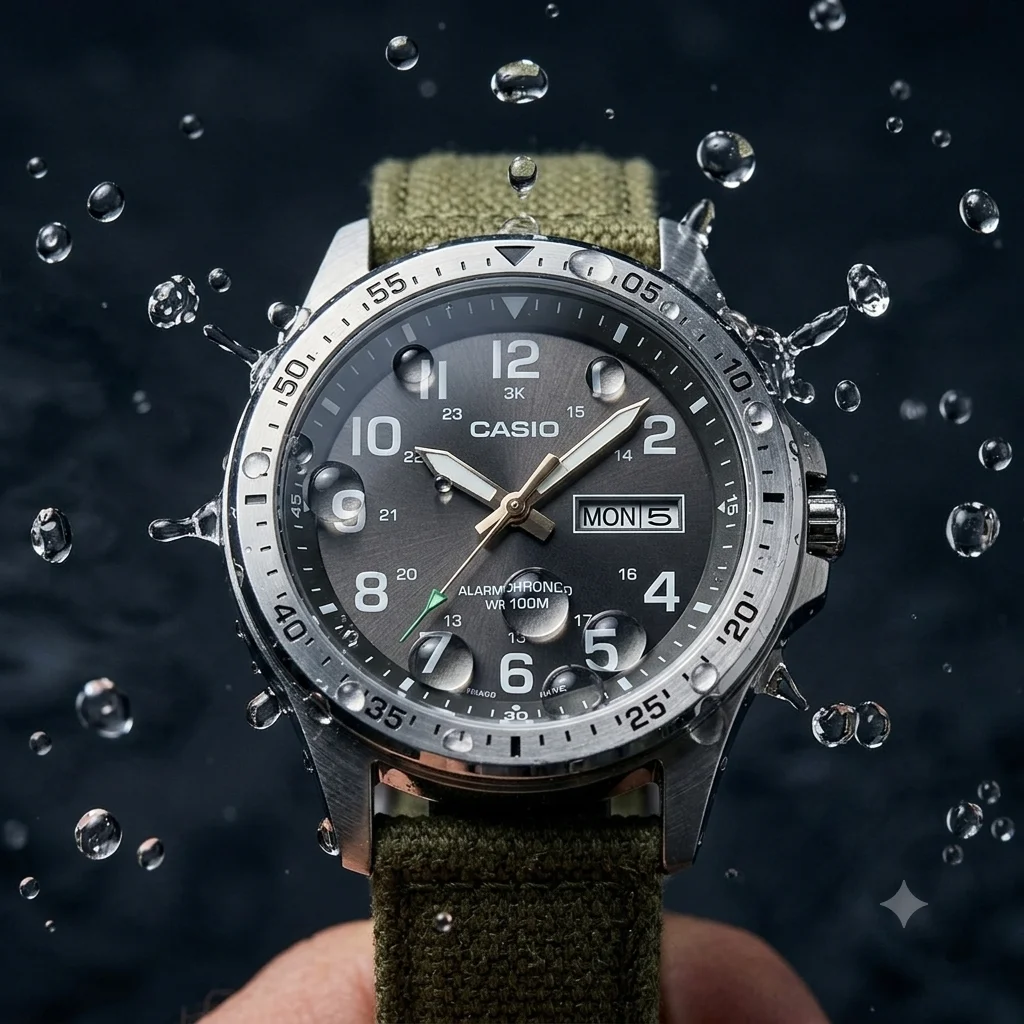
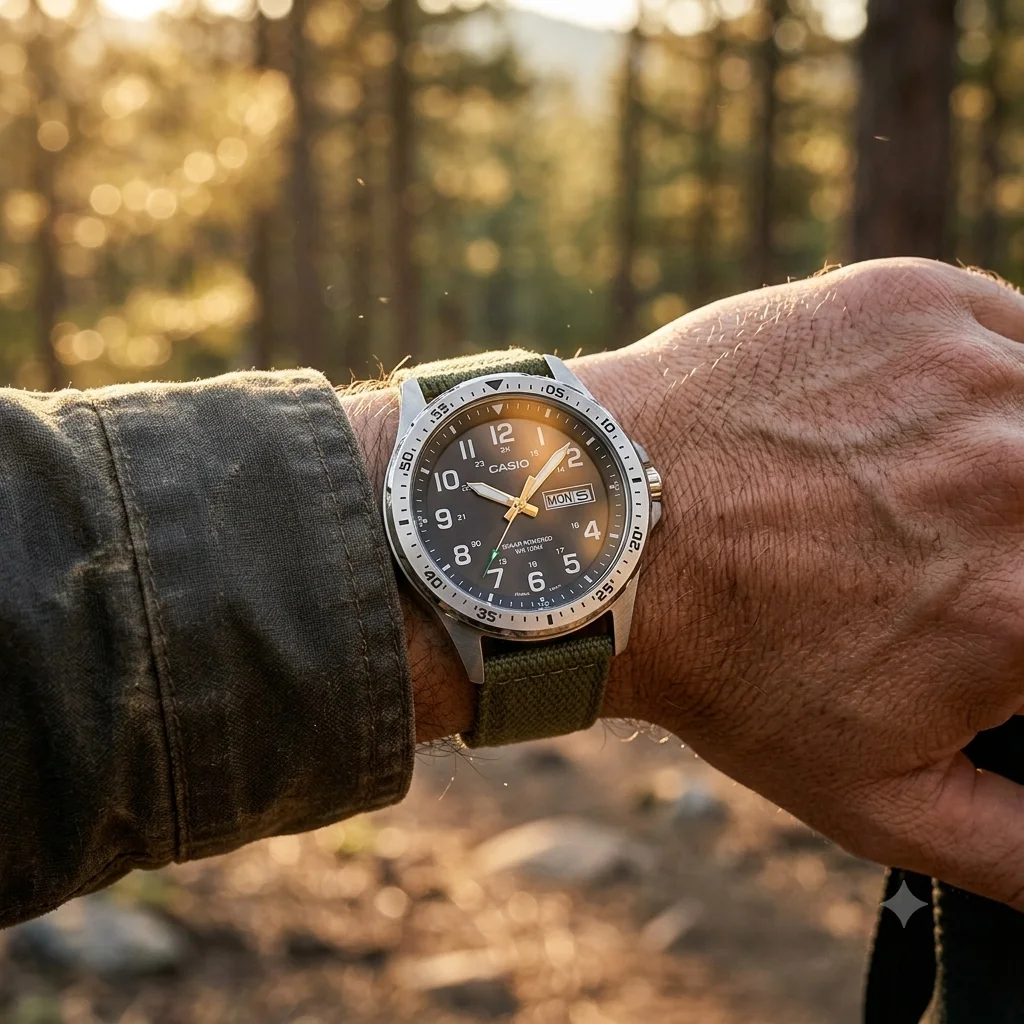
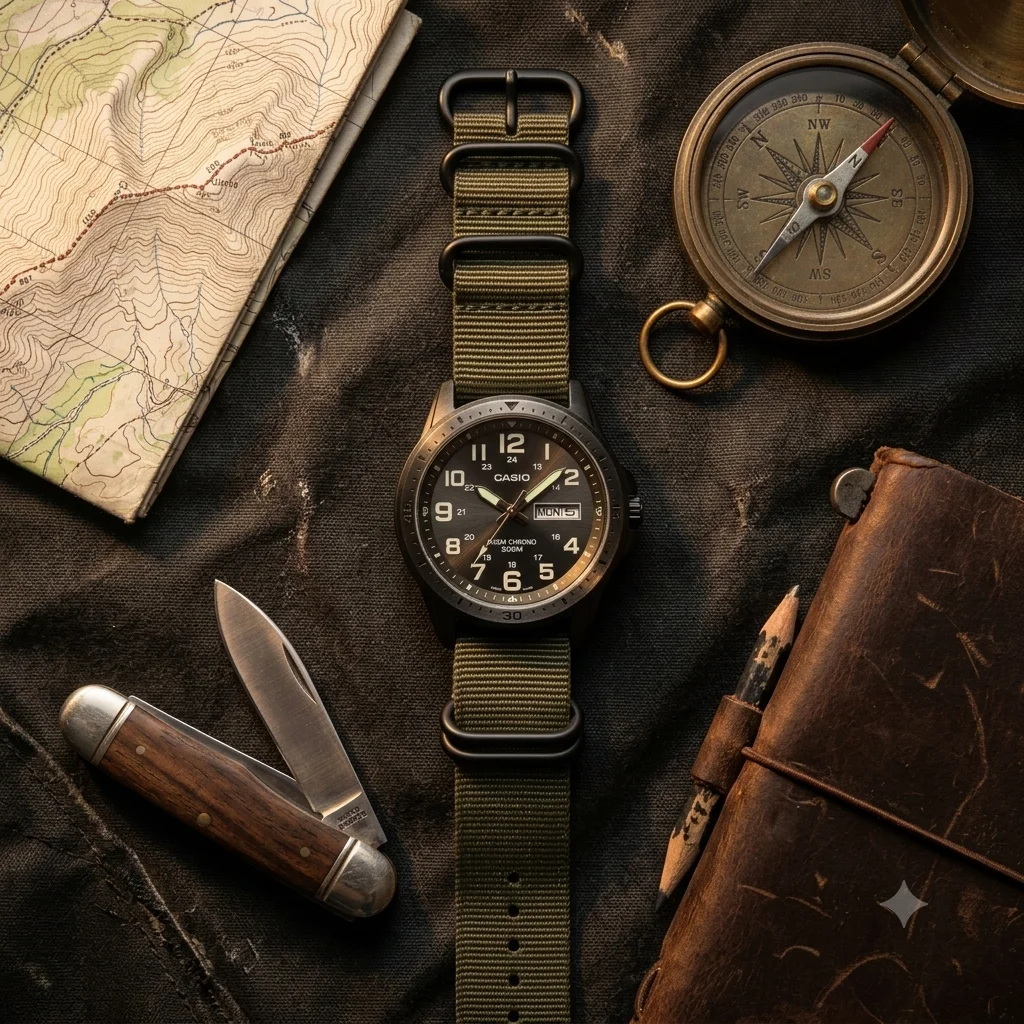
The elements series
One watch. Every element.


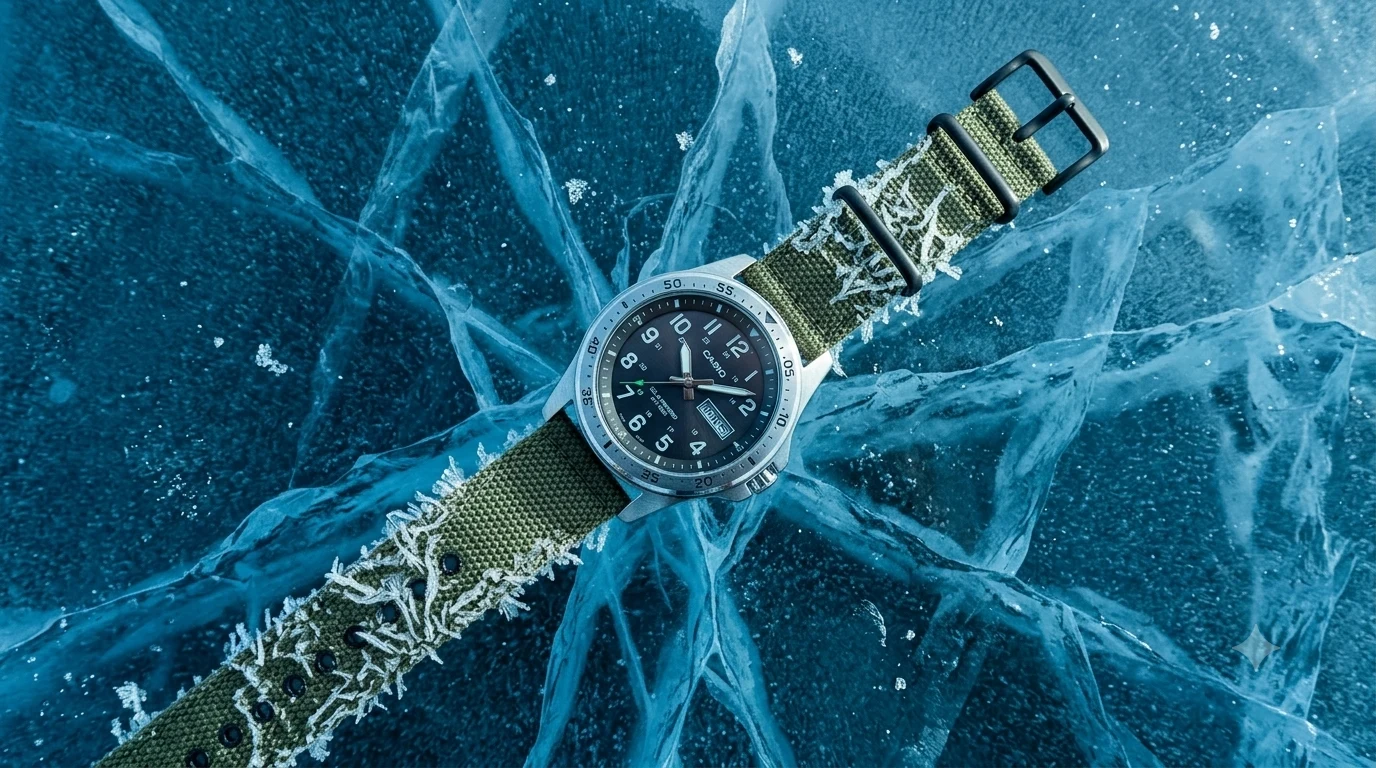
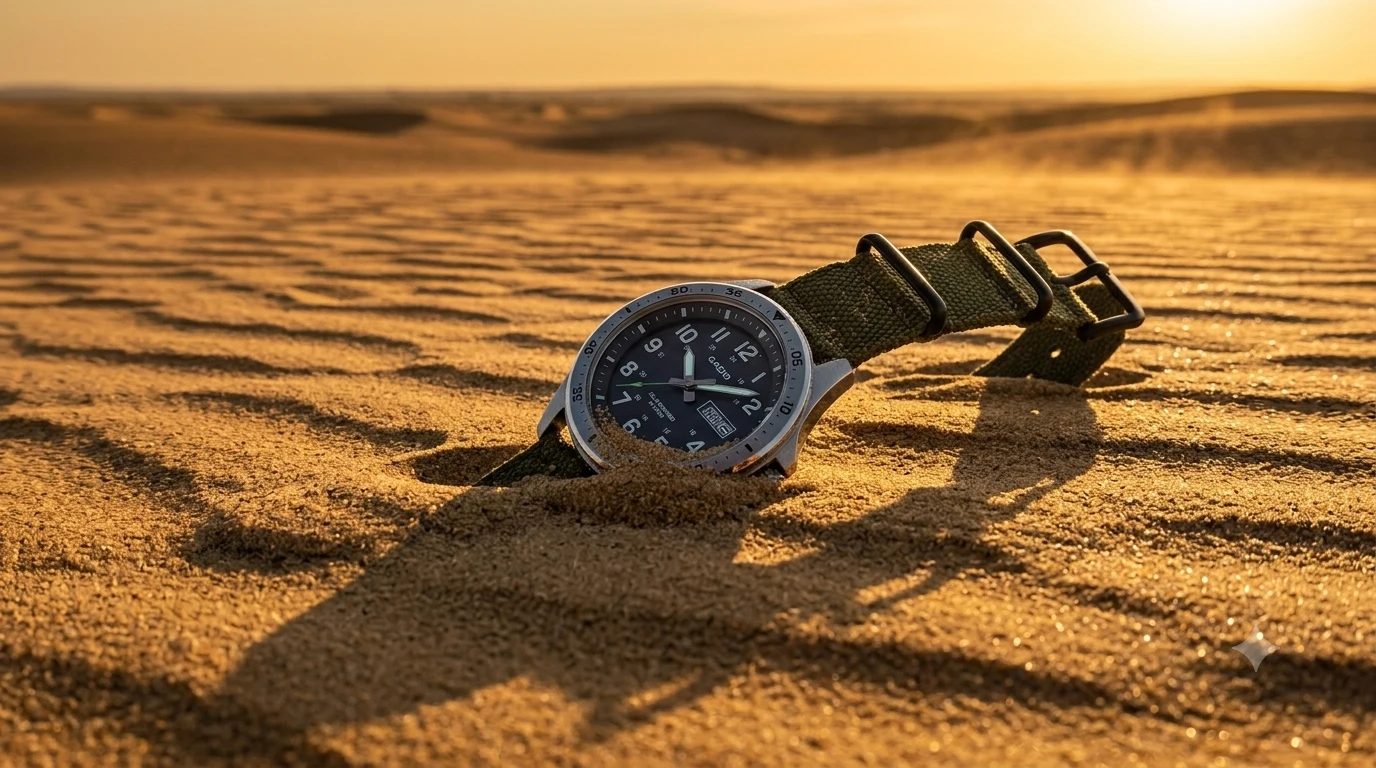
Stylized renders of the MTPS120L — because a watch this dependable deserves a little mythology.
What it doesn't do (honestly)
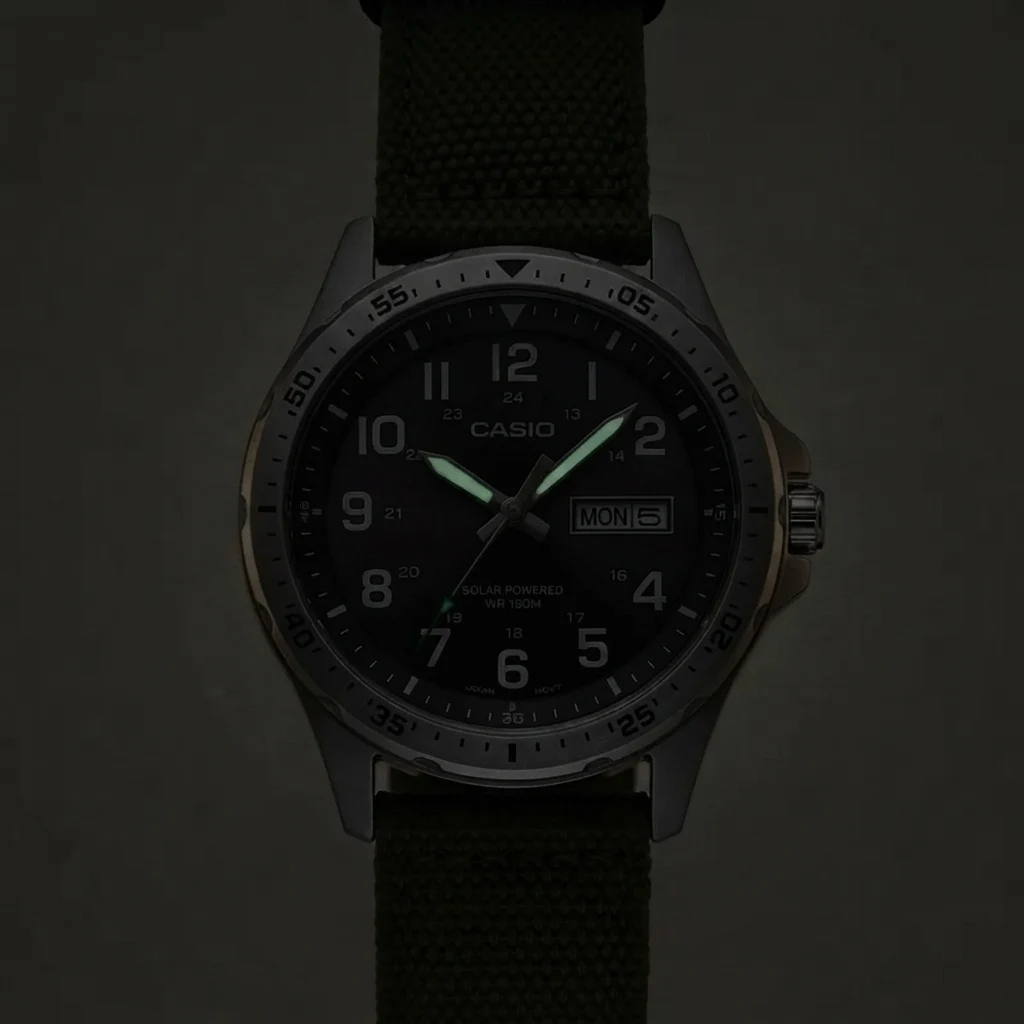
- The lume is weak. Only the hour and minute hands are painted, and owners report the glow fades in minutes. Treat this as a daytime watch — if night reading matters, look elsewhere.Unless you love it enough to fix it. A watchmaker or a lume specialist will strip the hands and repaint them in modern Super-LumiNova or similar, which glows for hours instead of minutes, and can do the markers while they are in there. Shop around: expect somewhere around $75–$200 depending on who does the work and how much of the dial you have done. Worth knowing before you commit — at this watch's price that is close to buying it twice, and because the case has to come apart, have the seals re-tested afterwards if you plan to swim in it.
- The stock strap is the weak point. The included nylon band is the most common complaint in reviews — scratchy, stiff, and not up to the watch head's quality. The good news: it takes any standard 22mm band (fix below).
- Mineral crystal, not sapphire. Normal at this price; it shrugs off daily wear but can scratch where sapphire wouldn't.
Day-one setup
The Spanish days aren't a defect
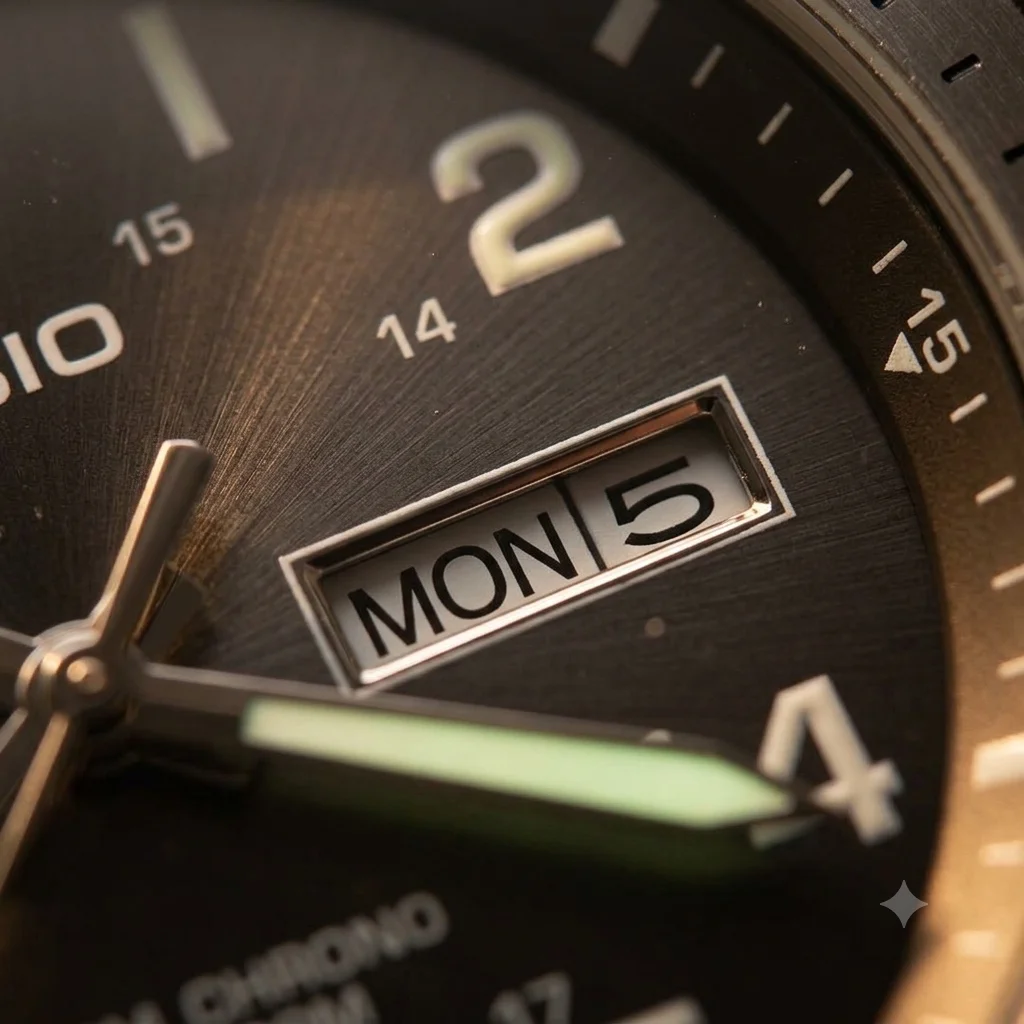
Set the day for the first time and you'll scroll past LUN, MAR, MIÉ on your way to Monday, and reasonably wonder whether you're going to be reading Spanish every other day for the life of the watch. You're not. Pick English once and it stays English.
14 slots, not 7
A bilingual day disc carries every weekday twice — once in English, once in Spanish — so it has fourteen positions instead of seven. That's the whole reason both languages exist on one wheel.
It jumps two at midnight
Fourteen slots, seven weekdays, one calendar day per night — so the movement has to advance two positions at midnight, not one. Skipping the other language is exactly what keeps you in the one you chose, night after night.
Setting steps one at a time
Manual advancement walks the wheel one slot per press, so it marches you through both languages. Just keep going until the English day you want appears — that's the language the midnight jump then locks in.
- Don't set the day or date late at night. Casio's standard guidance for its day-date movements is to stay out of roughly 9pm to 3am, because the changeover gears are already engaged and forcing the wheel then can damage them. Some modules quote a narrower window; the wide one is the safe habit. Set it at lunchtime.
- Watch the 12-hour trap. This is a 12-hour analog dial, so it's genuinely easy to set the hands half a day off. The tell shows up later: your day and date flip over at noon instead of midnight. The fix is just to run the hands forward another 12 hours.
The mechanism above is how bilingual day wheels work generally, not a quote from this model's manual. For the exact procedure and timing window for your watch, check the module number on the caseback against Casio's own manual library at casio.com.
If we're being greedy
Four things from a knockout
This is what separates a great first watch from a near-perfect one. If Casio ever ships this exact watch with these four upgrades, it ends the conversation:
A sapphire crystal
The mineral glass works, but sapphire shrugs off scratches for decades. The good news: aftermarket sapphire upgrades exist for this case — the one flaw you can actually fix.
A sweeping seconds hand
The quartz tick is honest, but the smooth glide of an automatic’s seconds hand is half the romance of mechanical watches. That’s rung three and four of the ladder calling.
Real, lasting lume
Hours of glow across the full dial — numerals and markers, not just two hands that fade in minutes.
A rotating bezel
The 60-minute bezel is fixed. A click-turning dive-style bezel would make it a genuine tool watch — timing parking meters, pasta, dives.
None of these change the verdict at this price — they're the reasons your second watch exists.
The complete-setup upgrade path
Complete the setup
Order these two with the watch and you fix its only real flaw the day it arrives — a five-minute, first-try strap swap.
1 · The watch
Casio MTPS120L Series (Green)
Solar, 100M WR, day-date. Typically $100–$150.
View on Amazon2 · The strap fix
Archer 22mm quick-release silicone
Soft, waterproof, and the Shamrock Green matches the dial. Solves the stock-band complaint the day the watch arrives.
View on Amazon3 · The essential tool
WOCCI spring bar tool
The one tool every watch owner ends up needing. Swap any strap in minutes — your first taste of working on your own watch.
View on Amazon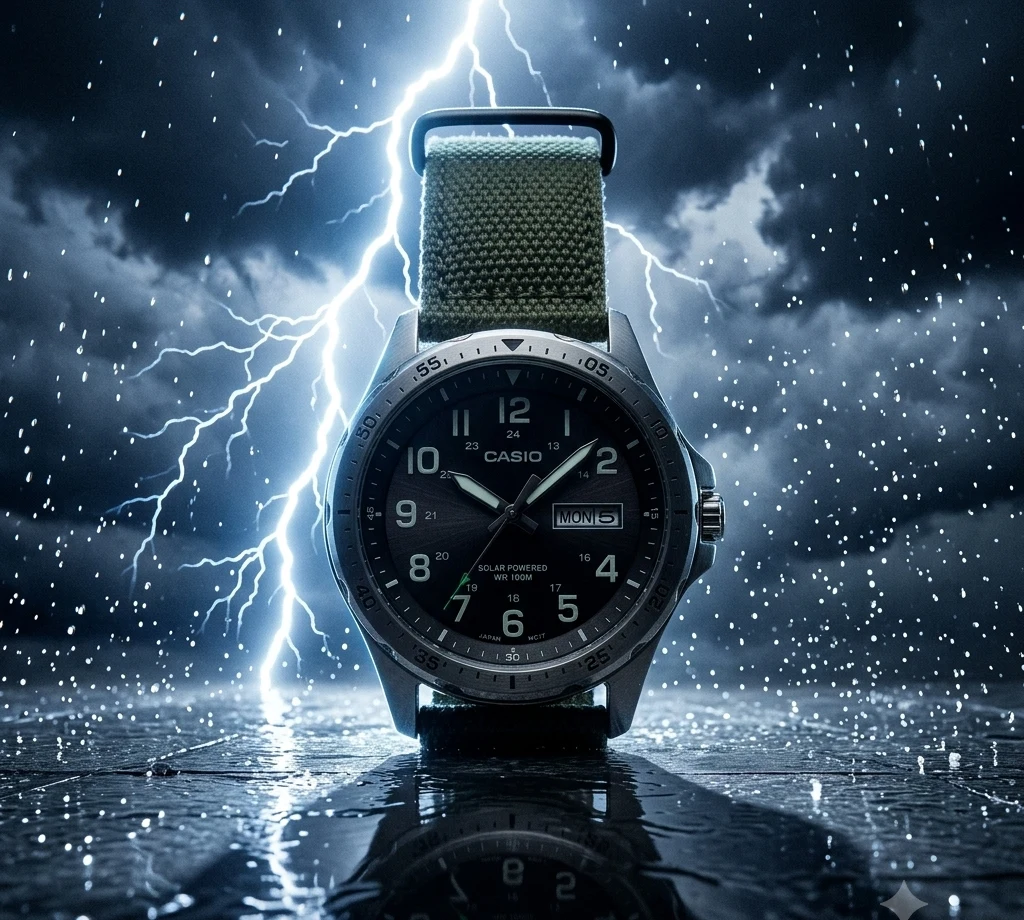
One watch. Zero maintenance.
A lifetime hobby, started right.
As an Amazon Associate, The Horologist earns from qualifying purchases.
Frequently Asked
Questions About the MTP-S120L Solar Field
No. It runs on Casio's Tough Solar system, which charges a rechargeable cell from any light source — daylight, office lighting, a desk lamp. A full charge runs for months in darkness. There is no coin cell to replace, so there is no caseback opening and no trip to a jeweller every few years.
Yes. It is rated 100m (10 ATM), which covers swimming, snorkelling and showering without concern. That is genuinely generous for a field-styled watch at this level. It is not a saturation diver, so leave the deep-water and helium-environment work to purpose-built dive watches.
Casio lists the case at 42mm wide and 49mm lug to lug, 10.9mm thick, and it wears that way: moderate, because the bezel is slim and most of the diameter goes to dial. Field styling and a nylon strap help it sit flat. Buyers with wrists under about 6.5 inches should still check the fit before committing.
No, it uses mineral crystal. Mineral shrugs off everyday knocks well but will scratch where sapphire would not — a fair trade at this level, and the crystal is replaceable if it ever gets marked. If a scratch-proof front is a hard requirement, look at sapphire-equipped alternatives.
Weak, and worth knowing before you buy. Only the hour and minute hands carry luminous paint, and the glow fades within minutes rather than lasting the night. This is a daytime watch. If reading the time in the dark matters to you, this is the wrong watch to choose.
Complete the look
A fresh strap changes the whole watch.
Not ready today? Adding it to your cart keeps your pick saved.