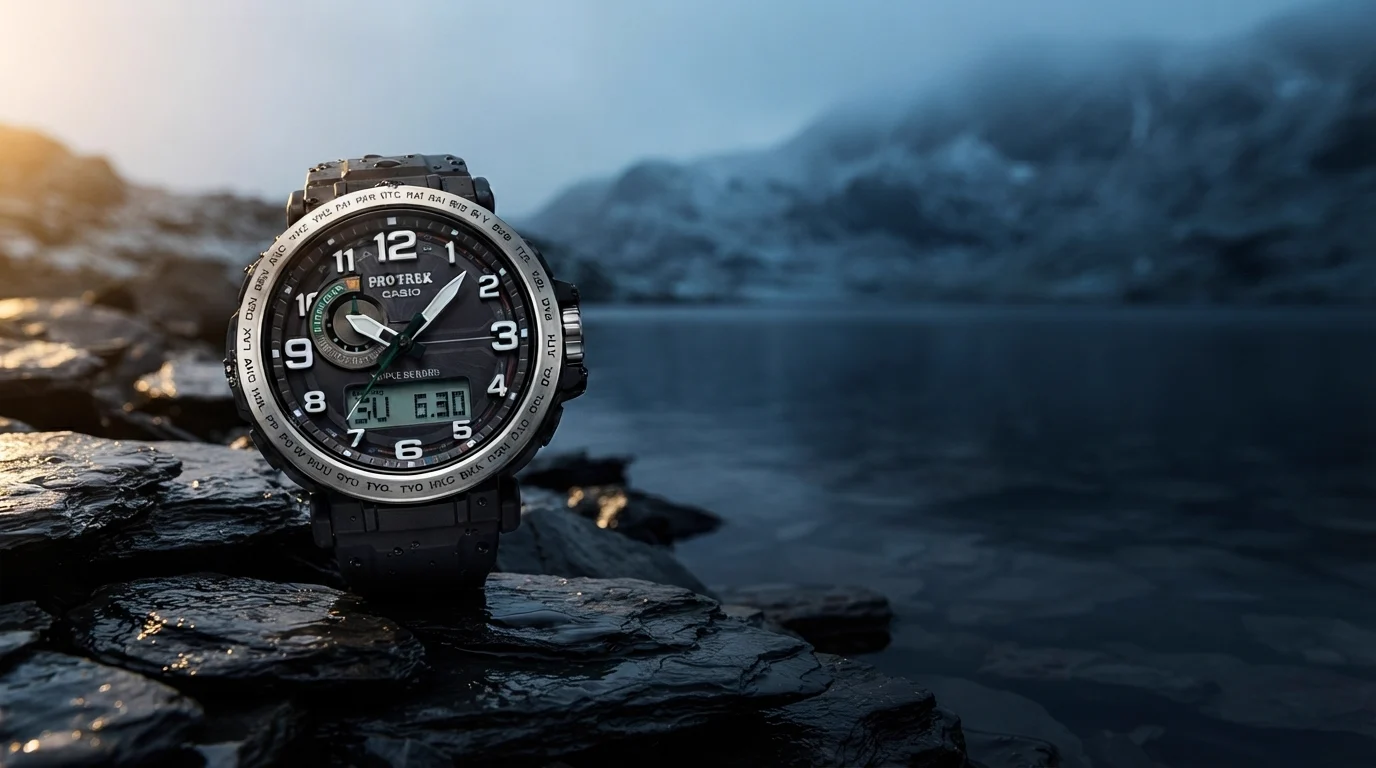
Casio · Pro Trek · Ref PRG601-1
The watch that tells you
where north is.
Most watches tell the time. This one reads the mountain: direction, altitude, pressure and temperature, on a case that never needs a battery.
51.6mm
Resin & steel
100m
Water resistant
Tough Solar
No battery change
-10 C
Low-temp rated
The party trick that is actually useful
A hand that points north
Press the compass button and a hand swings round to magnetic north, holding it for a full minute of continuous reading while the digital display gives you the bearing in degrees and one of sixteen points.
It corrects for magnetic declination, so the north it shows can be true north rather than magnetic. That is the difference between a novelty and an instrument.
Triple Sensor, plainly
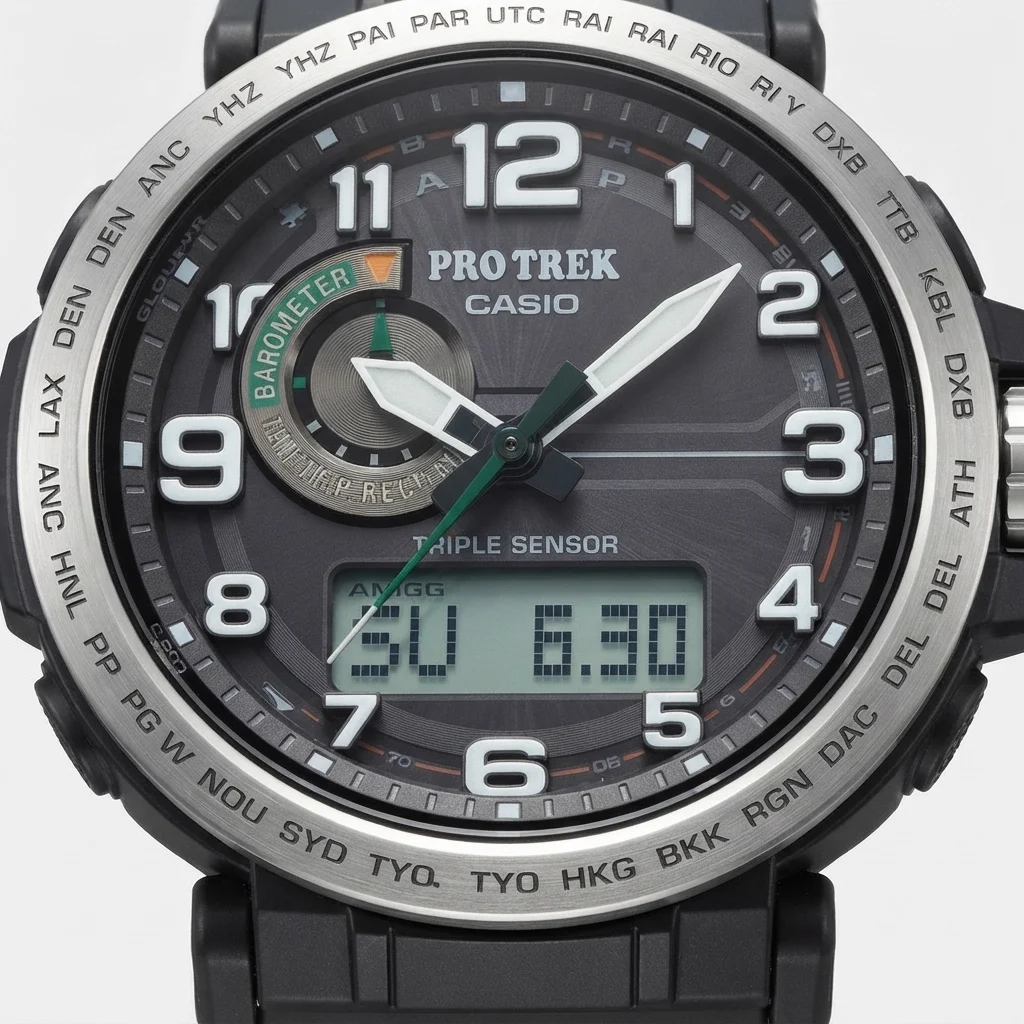
What each sensor actually measures, straight from Casio's specification.
Digital compass
16 points, 0-359 degrees in 1 degree steps, 60 seconds of continuous reading. Bidirectional calibration and magnetic declination correction. A hand swings round to show north.
Altimeter
-700 to 10,000 m, in 1 m steps. Samples every second for the first three minutes, then every 5 seconds or 2 minutes as you choose. Relative readings, 30 stored records, and an automatic log of high and low points and cumulative ascent and descent.
Barometer
260 to 1,100 hPa in 1 hPa steps, with a tendency graph, a hand that shows the pressure differential, and an alarm that beeps when pressure moves sharply.
Thermometer
-10 to 60 degrees C, resolved to a tenth of a degree.
Where it earns its size
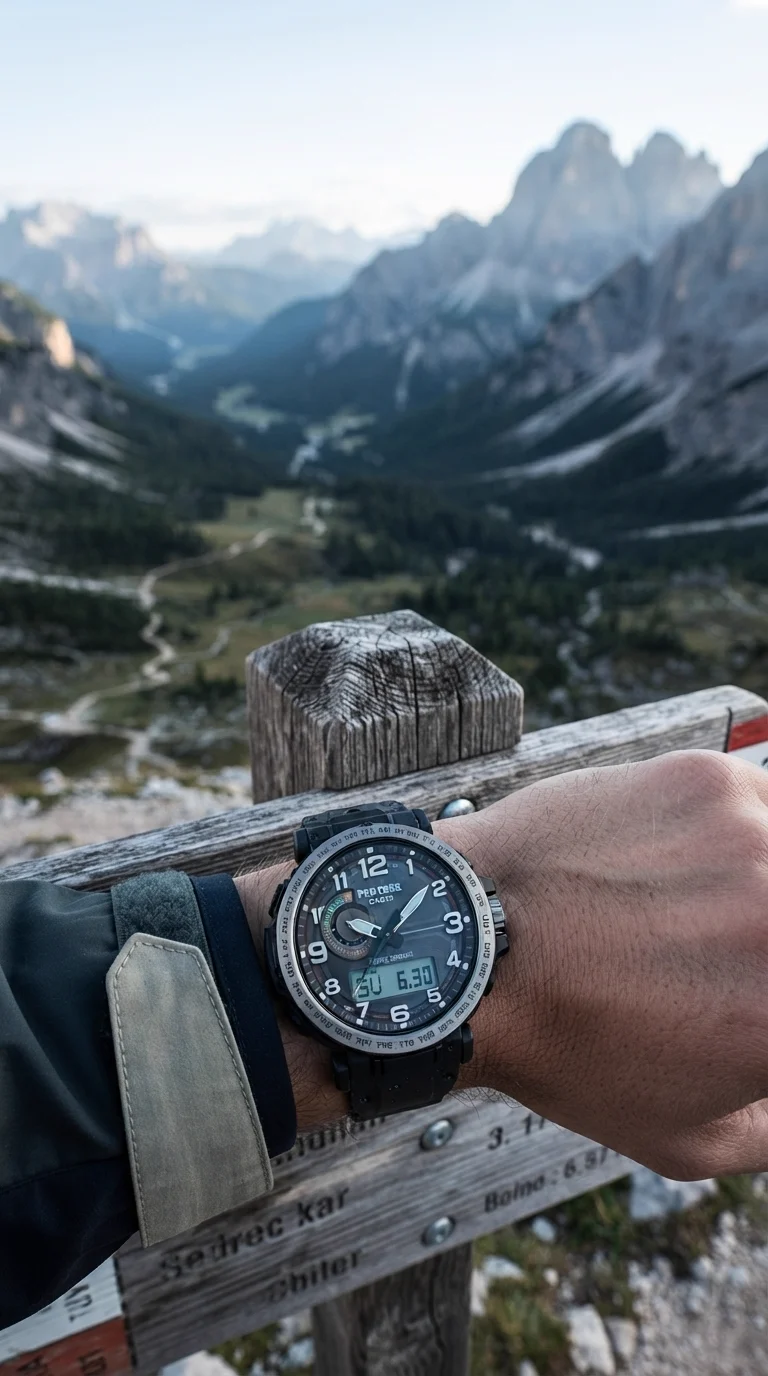
51.6mm, and worth it here
This is a big watch. On a wrist under a jacket cuff it is undeniably present, and we would not pretend otherwise. What the size buys you is a dial you can read at a glance while moving, and buttons you can find wearing gloves.
It weighs 59 grams. The case is bio-based resin over a stainless steel core, the crown screws down, and the whole thing is rated to keep working at -10 C.
It runs on light
Tough Solar turns daylight into the power for everything above. A full charge runs seven months in normal use with no further light at all, and twenty-five months if you put it away in the dark with power saving on.
Which means the practical answer to when do I change the battery is: you do not. Leave it near a window between trips and it is always ready.
Two lights, not one
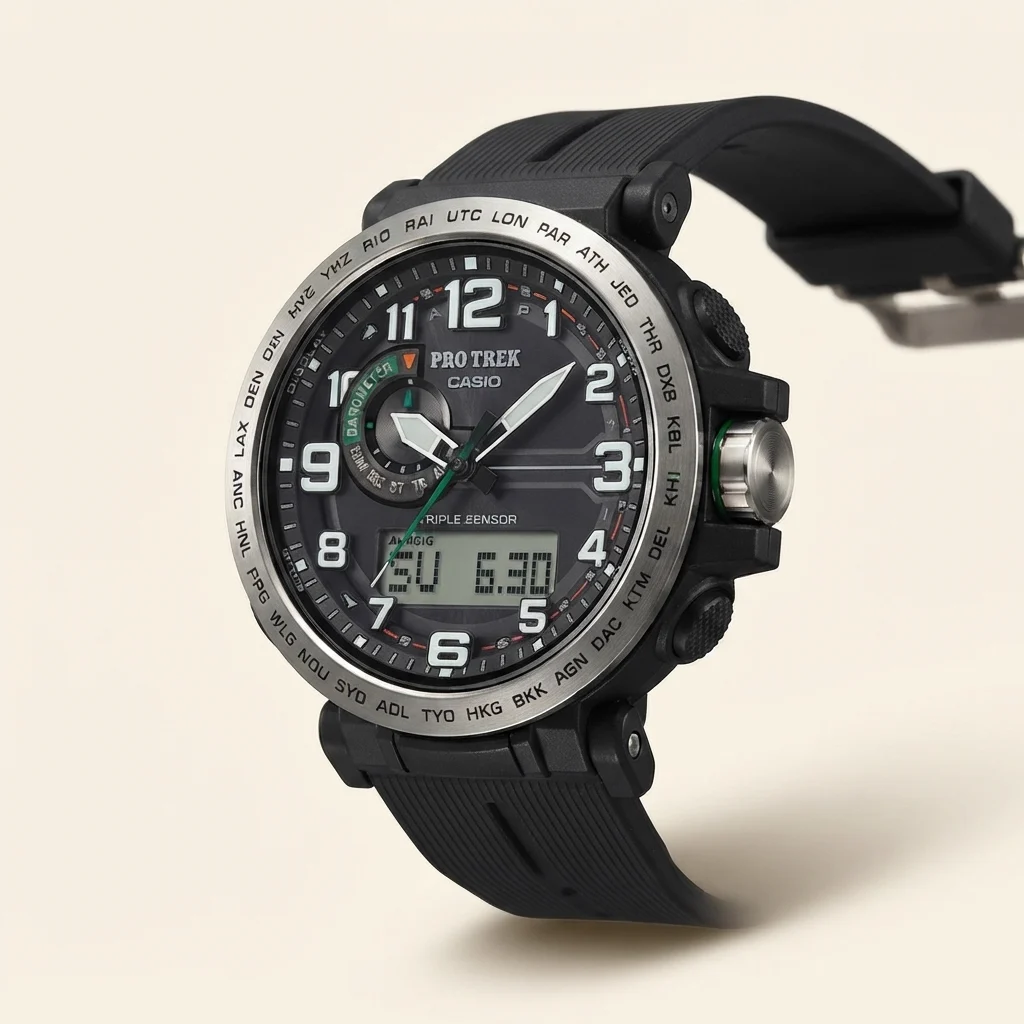
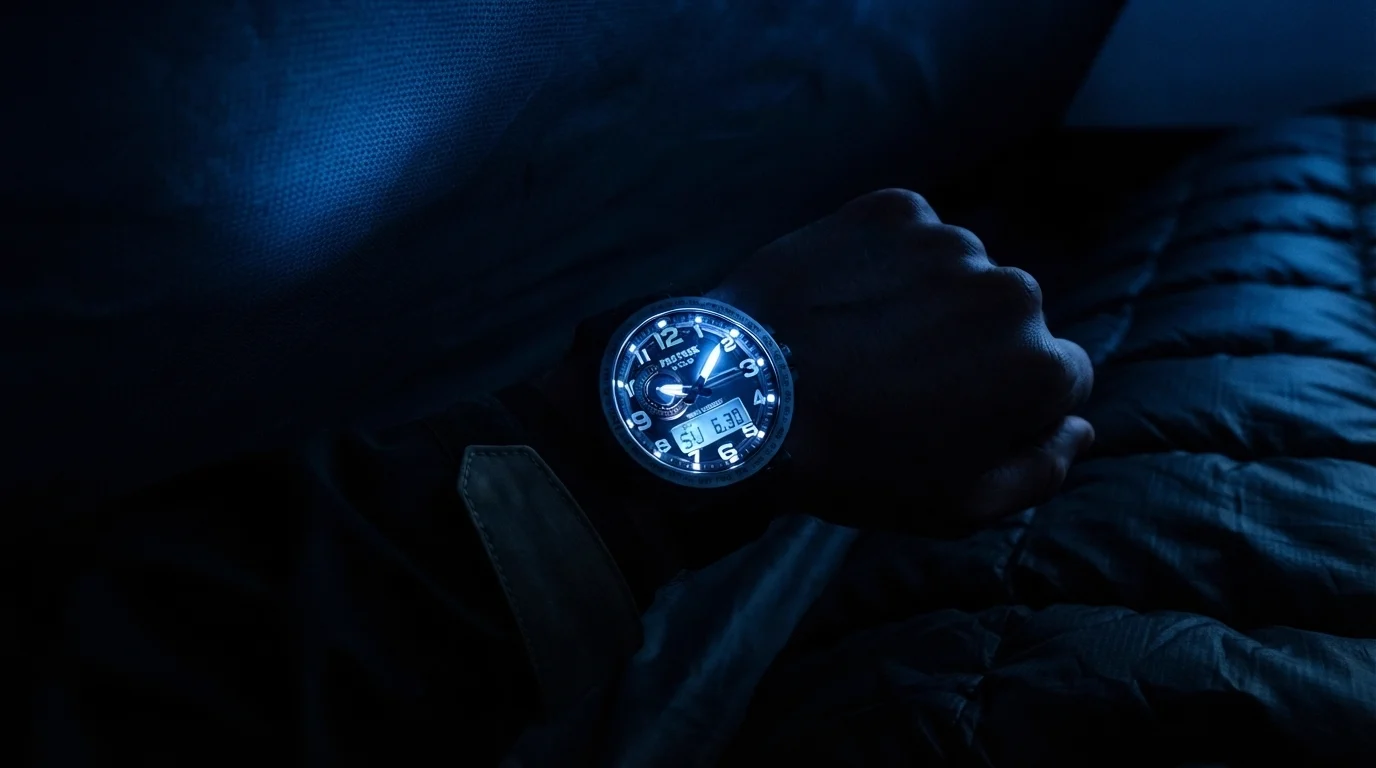
There is an LED for the face and a separate LED backlight behind the digital display, both full-auto with a selectable duration and an afterglow. Tilt your wrist in a dark tent and the whole watch lights, analogue and digital together. Neobrite on the hands carries the rest.
The half the manual leaves out
How to actually use it
Casio’s manual is a reference table: it tells you which button enters which mode. It is close to silent on the things that decide whether a reading is any good. This is what owners work out in the first month.
The compass: hold it flat, and stand away from your own gear
One press and the central seconds hand swings round to magnetic north while the digital window at six o’clock gives you the bearing in degrees and one of sixteen points. It reads for sixty seconds and then stops on purpose — a magnetometer running continuously is the fastest way to flatten any watch.
Two habits decide your accuracy, and neither is in the manual’s first page. Hold the watch genuinely level, because tilt is the single largest error source on a wrist magnetometer. And step away from metal — car doors, trekking poles, belt buckles and the phone in your other hand will all pull the needle. Owners who do those two things consistently report it agreeing with a baseplate compass. If it ever disagrees with a reference you trust, run the bidirectional calibration rather than assuming the sensor is broken. If you are navigating from a paper map, set the magnetic declination for where you are standing, because the map is drawn to true north and the watch is pointing at magnetic north.
The altimeter: it is a barometer wearing a different hat
This is the feature people misjudge. There is no GPS here. The watch infers height from air pressure, which means a weather front moving through will change your altitude reading while you are standing perfectly still. That is not a fault in the watch; it is the physics of the method, and every barometric altimeter ever made does it.
So the owner’s rule is: set a reference before you set off. A trailhead sign, a spot height on the map, a phone GPS fix in the car park — anything known. Do that and the -700 to 10,000 m range in 1 m steps behaves. Skip it and the number is decoration. Then treat it as a differential instrument rather than an absolute one: what it is genuinely good at is telling you how much you have climbed and how much is left, which is why the automatic log of high and low points and cumulative ascent is the part you will actually look at afterwards. On a long day, re-set the reference at any known altitude you pass; it stores thirty readings with the date and time against each, so marking a col or a summit as you pass it costs nothing.
One behaviour worth knowing, because it looks like a fault and is not: the altimeter samples every second for the first three minutes after you enter the mode, then settles to whichever interval you have chosen, five seconds or two minutes. That is why it feels alert the moment you call it up and lazy twenty minutes later. Nothing is wrong. If you want it responsive on a climb, choose the five-second interval and accept the slightly higher drain; if you are pacing a long day, two minutes is kinder to the cell.
The barometer: read the shape, not the number
Owners describe the same pattern: reliable over a day, restless hour to hour. Which tells you how to use it. A single reading off the 260 to 1,100 hPa scale is close to meaningless on its own; the tendency graph is the instrument. A steady line is settled weather, and a line falling away sharply is the one worth acting on — that is the change alarm’s entire reason for existing, and it is worth leaving on when you are sleeping outside.
The thermometer: on your wrist it is measuring you
Every owner finds this out and the manual mentions it about once. Worn, the watch sits against a body holding itself at 37 degrees, so it reads somewhere between the air and your arm and is wrong by a wide margin. For a real air temperature take it off, hang it in shade, and give it twenty to thirty minutes to settle. Do that and the -10 to 60 degrees C range, resolved to a tenth, is genuinely useful. Leave it on your wrist and the tenth of a degree is false precision.
Setting it up: the one thing that trips everybody
The controls are logical once learned and baffling on day one, and there is a specific reason: setting the time is split across two different buttons rather than living in one menu. Owners routinely think the watch is stuck when they have simply only found half the settings. Expect to sit down with it once. After that it is muscle memory, and the payoff is that each sensor is one press away instead of buried in a menu tree.
Keeping it fed
Tough Solar means light, not sunbathing: ordinary daylight through a window keeps it topped up, and a full charge runs seven months in the dark, or twenty-five in power save. The practical failure mode is not the sensors, it is a watch that lives under a sleeve all winter. Give it a windowsill on days it is not on your wrist and the question never comes up.
And know what power save actually does before it frightens you: left in the dark, the display goes blank and the hands stop. A watch pulled out of a drawer with its hands frozen at some arbitrary time looks broken, gets shaken, and occasionally gets returned. It is working exactly as designed. Bring it into the light and it catches itself up on its own — there is an automatic hand home-position correction for precisely this. While you are there, one small oddity that is also not a fault: the minute hand advances every ten seconds rather than once a minute, so you will see it creep.
Every number, and what it means
The full specification
Straight from Casio’s own specification for the PRG601-1, module 5497 — with a note on each one about why it matters, which is the column the official sheet leaves blank.
- Case
- 51.6 × 51.5 × 14.8 mm
- Wide, but only 14.8mm thick — the diameter is mostly bezel, which is why it reads smaller on the wrist than the number suggests.
- Weight
- 59 g
- The headline figure. A 51.6mm watch that weighs 59 grams is barely there, because the case, case back and band are resin rather than steel.
- Case and bezel
- Bio-based resin / stainless steel
- Resin case and case back, steel bezel. The resin uses castor oil and corn feedstock rather than petroleum.
- Band
- Soft urethane, fits 145–215 mm
- Check your wrist against that range before ordering; it is generous at the top end and fine for most.
- Crown
- Screw lock
- Screw it back down after setting. An unscrewed crown is how a 100m watch becomes a 0m watch.
- Water resistance
- 100 m
- Swimming and snorkelling, not diving. Do not press the buttons underwater.
- Low temperature
- −10℃ / 14℉
- The rated floor for the display. Below it the LCD slows; the watch is not damaged.
- Accuracy
- ±15 seconds per month
- Ordinary quartz accuracy. There is no radio or GPS sync on this reference, so expect to correct it a few times a year.
- Power
- 7 months / 25 months in power save
- From a full charge, in complete darkness. In normal use with any daylight it simply never runs out.
- Glass
- Mineral
- Scratches more easily than sapphire, shatters less. The right choice on a tool watch.
- Light
- Double LED, white, with afterglow
- Two separate lights — one for the dial, one behind the digital display — and you can choose how long they stay on.
- World time
- 29 cities + UTC
- One-touch UTC access, daylight saving on or off, and you can swap home city with the world-time city.
- Stopwatch
- 1/100 sec, to 23:59'59.99"
- Elapsed, split, and first-second place times.
- Timer
- Countdown to 60 minutes
- Set in 1-second steps.
- Alarms
- 5 daily, plus hourly signal
- Five is enough to run a day: wake, turn-around time, last bus.
- Calendar
- Full auto to 2099
- Never needs adjusting for month length or leap years.
- Hands
- Minute hand moves every 10 seconds
- Deliberate, not a fault. The hands also shift out of the way on demand so they never hide the digital display.
Figures verified against Casio’s published specification for the PRG601-1 (module 5497) on 29 August 2026.
What you are giving up
- No radio timekeeping. Some listings for this watch say “atomic”. Casio’s own specification lists no Multi-Band 6 and no radio reception — PRG is the Tough Solar line, PRW is the radio-controlled one. You set this watch yourself. The PRW-B1000 fixes this — Multi-Band 6 and Bluetooth →
- Mineral glass, not sapphire. It resists knocks well and is cheap to replace, but it will pick up fine scratches sapphire would shrug off. Only one Pro Trek in Casio’s US line-up has sapphire, and this is it →
- It is 51.6mm across. On a smaller wrist that is a lot of watch, and it will catch on a cuff. The cheaper Pro Treks are no help here — the PRG270 and PRG340 are both wider than this one. The PRW-B1000 is 45.8mm across instead of 51.5mm, though heavier with it →
- 100m, not a dive rating. Swimming and weather are fine. This is not a substitute for a dive watch, and the sapphire upgrade below does not fix this one — the PRW-B1000 is also 100m. The 200m answer is a different watch entirely. The PRW-3500T is 200m and radio-controlled, on titanium →
If those matter to you
Casio Pro Trek PRW-B1000-1
Sapphire with an anti-reflective coating, radio timekeeping on Multi-Band 6 plus Bluetooth sync to your phone, and a case that measures 45.8mm across rather than 51.5mm. The same Triple Sensor underneath. It is roughly twice the money and twenty grams heavier, and it is still only 100m — so it is the answer to three of the four objections above, not all four.
See the PRW-B1000-1 →Five daily alarms · World time · 1/100s stopwatch
A true utility watch
Direction, height, pressure, temperature and light to read it by — on a watch that charges itself and asks nothing of you between trips.
Add to Cart on Amazon$250–$500 · adding to cart keeps it linked to us for about 90 days
Complete the look
A fresh strap changes the whole watch.
Not ready today? Adding it to your cart keeps your pick saved.